
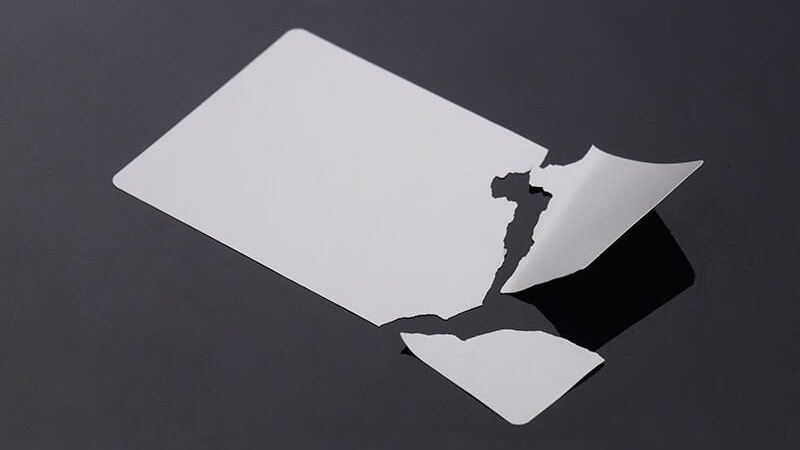
Fraudulent warranty claims and product tampering cost global manufacturers millions of dollars every year. While standard security stickers can often be bypassed with heat guns or chemical solvents, ultra-destructible labels provide an absolute physical defense.
This technical guide breaks down how these labels work, the specific material grades available for industrial surfaces, and how procurement managers specify them. Explore how the electronics, pharmaceutical, and logistics sectors use this innovative measure to maintain total product integrity.
What is an Ultra-Destructible Label?

An ultra-destructible label (often referred to as a destructible vinyl label or eggshell sticker) is a highly specialized security tool. It is designed specifically to prevent unauthorized access and component swapping.
Once applied and fully cured, it cannot be removed in one piece. Unlike standard PET stickers that might peel off cleanly if heated, any attempt to pick, peel, or scrape a destructible label causes the face material to shatter into hundreds of tiny fragments. This leaves clear and irreversible evidence of tampering.
The working mechanism of these labels relies on a delicate balance of engineering and material science:
- Aggressive Permanent Adhesive: A high-tack, solvent-based acrylic adhesive creates a permanent bond to a variety of high-energy and low-energy surfaces. This bond is engineered to be stronger than the label’s own face material.
- Low Tensile Strength Base: The labels are manufactured from a specialized destructible cast vinyl. This material possesses incredibly low tensile and internal cohesive strength, meaning the vinyl is deliberately brittle and fragile.
- Irreversible Fragmentation: When a thief attempts to lift the label edge, the aggressive adhesive holds the bottom layer firmly to the product surface. The upward pulling stress causes the weak vinyl face to instantly fracture and break apart like an eggshell.
This irreversible physical damage is exactly why ultra-destructible labels are universally used as warranty seals. Their tamper-evident properties make them a critical tool for safeguarding high-value items where visual proof of tampering is required.
5 Types of Ultra-Destructible Labels for Industrial Use
Ultra-destructible labels are not a generic commodity. Depending on your application surface and dispensing method, you require specific grades of brittleness.
Below is a detailed technical look at the specific grades we engineer at Shosky Security to meet complex application needs:
1. Co-extruded Destructible Labels
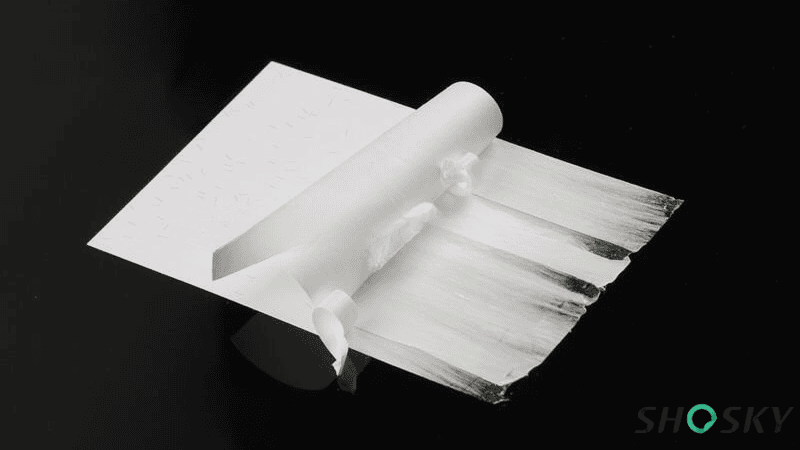
These labels are among the most widely used types of ultra-destructible labels in the market today. Made from PP synthetic paper, co-extruded destructible labels are designed to adhere effectively to uneven or flexible surfaces. Their primary function is to self-destruct into small fragments upon any tampering, providing a clear and irreversible indication of unauthorized access.
Additionally, the excellent printability of co-extruded labels makes them suitable for displaying critical information like logos, barcodes, or serial numbers clearly and durably.
- Material Composition: PP synthetic paper with a balance of stiffness and flexibility.
- Key Features: Excellent printability for logos/barcodes; withstands temperatures from -5℃ to 80℃; durable for both indoor and outdoor use.
- Best Application: Logistics, supply chain tracking, and general packaging, where surfaces might be slightly uneven.
2. Foamtac Destructible Labels

Foamtac destructible labels are made from a foam-like vinyl material that provides elasticity along with waterproof and oil-proof properties. Their unique layering effect ensures that removing these labels results in complete destruction, leaving behind only residue, so they cannot be peeled off entirely or reused.
- Material Composition: Polystyrene (PS) face stock with a film thickness of 165 microns.
- Key Features: Waterproof and oil-proof; thicker foam-like texture; aggressive acrylic adhesive; unique layering effect for high security.
- Best Application: High-value asset tracking in demanding environments where moisture or oil is present.
3. High-Brittle Destructible Labels (HG80 & HK80)

HG80 and HK80 destructible labels are made for medium to large-sized tamper-evident applications. These labels use low-brittle-grade polyethylene film that fractures irreversibly into fragments when tampered with. They are designed for operational efficiency, depending on whether you need rolls or sheets.
- Material Composition: Low-brittle-grade polyethylene film (80-micron thickness).
- Key Features: Excellent printing performance; die-cutting compatibility; withstands -5℃ to 80℃; HG80 comes in rolls, HK80 comes in sheets.
- Best Application: Large flat surfaces such as shipping crates, computer towers, machinery, or sealing larger boxes.
4. Medium-Brittle Destructible Labels (MG80)
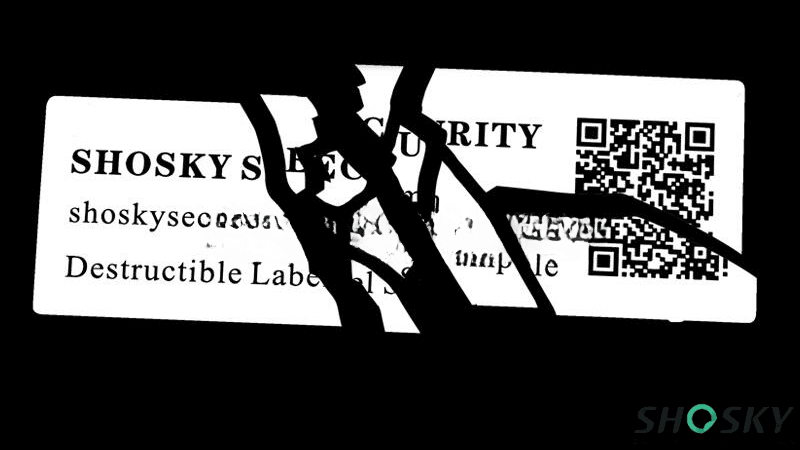
MG80 destructible labels are medium-brittle-grade vinyl labels designed for small to medium-sized applications, particularly those with curves. Unlike highly brittle labels that might snap when bent, the MG80 conforms well to irregular surfaces while still breaking apart into tiny flakes upon tampering.
- Material Composition: Medium-brittle-grade vinyl with 80-micron polyethylene film.
- Key Features: Verified flexibility for curved surfaces; impossible to reuse; compatible with various printing methods.
- Best Application: Curved surfaces like jar necks, cable seals, or small, rounded electronic components.
5. Hologram Destructible Labels
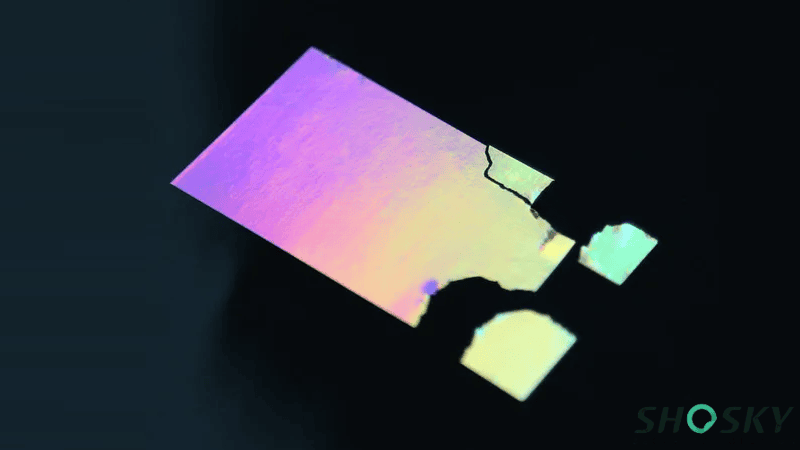
Hologram destructible labels combine security with visual appeal, featuring a holographic effect on destructible vinyl material. The holographic finish adds an extra layer of sophistication and authenticity to products, making them extremely difficult to counterfeit.
- Material Composition: Polyethylene (PE) destructive film (70 microns) with a holographic layer.
- Key Features: Dual security (Fragmentation + Holography); visually striking; cannot be repositioned.
- Best Application: Anti-counterfeiting for luxury goods, official documents, and high-end electronics, where brand image is paramount.
Ultra-Destructible Labels vs. VOID Security Labels

A common question procurement teams ask is whether they should specify a Destructible Vinyl Label or a VOID Polyester Label. While both are excellent tamper-evident solutions, their chemical mechanisms are completely different.
Ultra-Destructible Labels rely on the physical face material breaking apart into fragments. VOID Labels, typically made of tough PET material, rely on a chemical adhesive separation.
When a VOID label is peeled, the plastic film remains perfectly intact. However, a hidden message (like “VOID” or “OPENED”) is left permanently on the product surface.
Here is a technical comparison to help you specify the right label:
| Feature | Ultra-Destructible Labels (Vinyl/PE) | VOID Polyester Labels (PET) |
|---|---|---|
| Tamper Mechanism | Fragmentation: Breaks into tiny pieces like an eggshell. | Pattern Release: Leaves a "VOID" or "OPEN" message on the surface. |
| Reusability | Impossible. The label is destroyed. | Impossible to re-stick without showing the "VOID" pattern. |
| Surface Suitability | Excellent for both smooth and slightly textured surfaces. | Best for smooth, non-porous surfaces (glass, metal, glossy plastic). |
| Flexibility | Moderate to High (MG80/Co-extruded types). | Low (PET is stiffer). |
| Primary Use Case | Warranty seals over screw holes; Asset tags; Anti-counterfeiting. | Packaging seals (box closures); Software seals; Door seals. |
| Visual Deterrent | High. The fragmented mess is immediately obvious. | High. The hidden message is revealed instantly. |
Core Industrial Applications of Ultra-Destructible Labels
The versatility and tamper-evident nature of ultra-destructible labels make them a perfect fit for a wide range of industries where security and product integrity are non-negotiable.
Automotive and Aerospace Industries

In the automotive and aerospace manufacturing sectors, these labels are essential for ensuring the traceability of critical components. They are applied as authenticity tags on engine parts, airbags, and calibrated tools, guaranteeing that only genuine OEM parts are used.
Additionally, they are used to seal maintenance inspection panels. This provides undeniable proof that sensitive mechanical systems have not been bypassed or tampered with by unauthorized mechanics.
Pharmaceuticals and Healthcare Compliance
In the pharmaceutical industry, ultra-destructible labels play a vital role in maintaining the integrity of medical packaging. They are applied tightly across the seams of prescription boxes and diagnostic equipment kits.
Because the label cannot be removed intact and reapplied, patients and doctors are instantly assured of product safety. They know immediately that the medication has not been diluted or tampered with during transit.
Electronics Warranty Protection
For electronics and high-value hardware, ultra-destructible labels offer the ultimate protection against unauthorized repairs. Major laptop and smartphone manufacturers use ultra-destructible vinyl labels as a warranty seal directly over the chassis screw holes.
If a customer attempts to open the device using a screwdriver, the label instantly fragments. This visual proof instantly voids the warranty, saving tech companies millions of dollars in fraudulent repair claims.

Government and Legal Sectors
In the public sector, ultra-destructible labels are invaluable for securing sensitive evidence and official equipment. They are heavily used to seal ballot boxes, secure forensic evidence containers, and tag classified IT assets.
The immediate fragmentation guarantees clear evidence of any unauthorized access. This simple label ensures strict legal compliance and maintains public trust in institutional processes.
The Ultimate Buyer’s Guide: Specification and Customization
Choosing the right security label involves two critical steps for packaging engineers. First, you must select the right base material for your physical environment. Second, you must integrate customization features to meet your supply chain tracking needs.
Step 1: Selecting the Right Base Material

Selecting the correct ultra-destructible grade is essential to prevent premature tearing on your production line. Consider the following variables:
- Surface Topography: If applying the label to a sharp curve, you must specify a medium-brittle (MG80) grade. For flat metal panels, use high-brittle (HG80).
- Application Environment: Ensure the adhesive is rated for your storage conditions. Standard acrylic adhesives work well indoors, but extreme cold storage requires specialized formulations.
- Dispensing Method: Inform your manufacturer if you are applying the labels by hand or using an automated labeling machine. Machines require high-tensile backing paper rolls to prevent snapping.
By accurately assessing your surface topography and storage environment, you prevent premature label failure and ensure the adhesive performs flawlessly on your production line.
Besides, when selecting ultra-destructible labels, it’s equally important to partner with a trusted supplier who has experience in producing tamper-evident labels. Choose a manufacturer with a solid track record to ensure product quality and reliability.
Step 2: Integrating Overt and Covert Customization

Once you have specified the physical material, you can elevate the security through advanced printing techniques.
Overt Features (Visible to the Eye):
- Variable Data Printing: We can print sequential numbering, unique barcodes, or QR codes on every single label using thermal transfer ribbons.
- Holographic Foils: As mentioned in the types section, adding a hologram makes the label virtually impossible to photocopy or reproduce.
- Brand Customization: High-resolution, full-color printing of your corporate logo and strict warning text strongly reinforces your brand authority.
Covert Features (Hidden Security):
- UV Invisible Ink: We can print hidden control markings that are completely invisible to the naked eye. These markings only illuminate under specialized UV blacklights.
- Micro-text: Extremely small text that looks like a line to the naked eye but can be read under magnification.
Integrating these overt and covert printing technologies transforms a simple, fragile sticker into a multi-layered security asset that is mathematically impossible for counterfeiters to duplicate.
Best Practices for Using Ultra-Destructible Labels

To ensure maximum security and proper fragmentation, assembly line workers must follow strict application guidelines. A poorly applied security label will fail to perform its primary function.
Follow these technical steps for flawless application:
- Surface Preparation: Ensure the target surface is completely clean and dry. Any industrial oils, dust, or moisture will neutralize the acrylic adhesive, allowing the label to be peeled off cleanly.
- Correct Sizing: Use the correct size label for the surface. A warranty seal that is too large may overhang an edge and catch on clothing, causing accidental breakage.
- Careful Handling: Avoid touching the adhesive side directly with your fingers. The natural oils from human skin will create a “dead zone” on the adhesive. Always handle the label by its extreme edges.
- Mandatory Dwell Time: Ultra-destructible labels do not reach maximum security instantly. The solvent-based adhesive requires a “dwell time” of at least 24 to 72 hours to fully cross-link and bond with the product surface.
FAQs
Q1: What makes ultra-destructible labels different from standard paper stickers?
Standard paper stickers have high internal cohesive strength, meaning they can often be peeled off in one or two large pieces if heated with a hair dryer. Ultra-destructible labels are manufactured from highly brittle cast vinyl that is chemically engineered to shatter into tiny flakes the moment picking or peeling occurs.
Q2: Can ultra-destructible labels be removed and reused on another product?
Absolutely not. The fundamental purpose of these labels is irreversible destruction. The adhesive is stronger than the face material. Any attempt to lift the label will destroy it entirely, making it physically impossible to transfer the label to a counterfeit product.
Q3: Can I print barcodes on ultra-destructible labels?
Yes. Modern ultra-destructible materials possess excellent top coatings that accept thermal transfer ribbon printing. This allows manufacturers to print crisp, highly scannable barcodes, QR codes, and sequential serial numbers directly onto the fragile surface for tracking purposes.
Q4: Do ultra-destructible labels work in extreme cold or freezer environments?
Standard acrylic adhesives may crystallize and lose their tack in sub-zero temperatures. However, you can specify a specialized “freezer-grade” adhesive during the procurement process. This ensures the label remains highly brittle and the adhesive stays permanently bonded even in cold-chain pharmaceutical storage.
Conclusion
Ultra-destructible labels offer unparalleled protection against tampering, counterfeiting, and unauthorized access. Their durability, customization options, and ability to provide visible proof of interference make them an essential solution for industries prioritizing security and authenticity. By investing in these advanced labels, businesses can safeguard their products, strengthen their brand reputation, and build trust with customers.
Eliminate Warranty Fraud with Shosky’s Ultra-Destructible Labels
Shosky is a trusted leader in tamper-evident solutions, offering ultra-destructible labels tailored to your industry’s needs. With a commitment to quality, customization, and fast delivery, we ensure that your products remain secure and authentic. Contact us today to explore our innovative labeling solutions and enhance your brand protection!