

Products often move through multiple facilities before reaching customers. Every stop in the supply chain creates another opportunity for tampering or counterfeiting. The OECD estimates that counterfeit and pirated goods make up as much as 2.3% of global imports, highlighting the scale of the problem manufacturers and logistics providers face worldwide.
Physical security alone no longer offers full supply chain visibility, and digital records without physical proof can be unreliable. Phygital protection connects tamper-evident packaging solutions with live digital tracking to close this gap. This article examines the technologies behind phygital protection and how they help organizations build safer, more transparent supply chains.
What is Phygital Asset Protection?
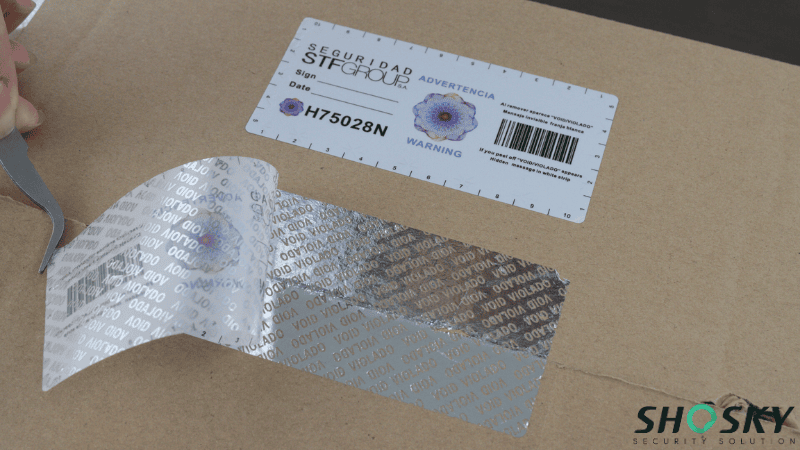
Phygital combines two words: physical and digital. In supply chain security, it means layering hardware-based tamper-evident technologies with cloud-connected digital tracking so that every breach leaves both a visible mark and a data trail. It is now a key structure in modern supply chain security.
Phygital asset protection solves this by linking each physical security feature to a digital identity via cloud-based databases and webhooks. The system operates through two connected layers:
- The Physical Layer: This layer includes tamper-evident seals, labels, tapes, and bags that show clear signs of interference (such as irreversible VOID patterns, shattered acrylics, or stress whitening) when handled without authorization. These tools protect the product at a material level and create immediate visual evidence if something goes wrong during transit or storage.
- The Digital Layer: This layer connects each physical security element to a digital record using QR codes, RFID tags, or serialized identifiers. Every scan at every checkpoint updates the shipment status in real time, giving supply chain managers live visibility into exactly where a product is via their existing ERP dashboards and whether its seal is intact.
When both layers work together, tampering becomes fully traceable. When a thief breaks a physical seal, the corresponding digital record flags the anomaly immediately. Real-time data flows to the team. Passive packaging becomes an active security system.
That is the core promise of tamper-evident digital tracking. This integration improves regulatory compliance (such as FDA Track-and-Trace mandates), strengthens supply chain visibility tools, and supports better decision-making in supply chain operations.
Ready to Get Tamper-Evident Digital Tracking for Your Supply Chain?
Start With A Low Minimum Order Quantity
Top 4 Tamper-Evident Digital Tracking Solutions
Modern supply chains require security tools that can do more than provide visual evidence of tampering. The hardware below combines physical protection with digital tracking capabilities, creating a stronger and more transparent security framework.
1. Serialized VOID Labels with QR Codes
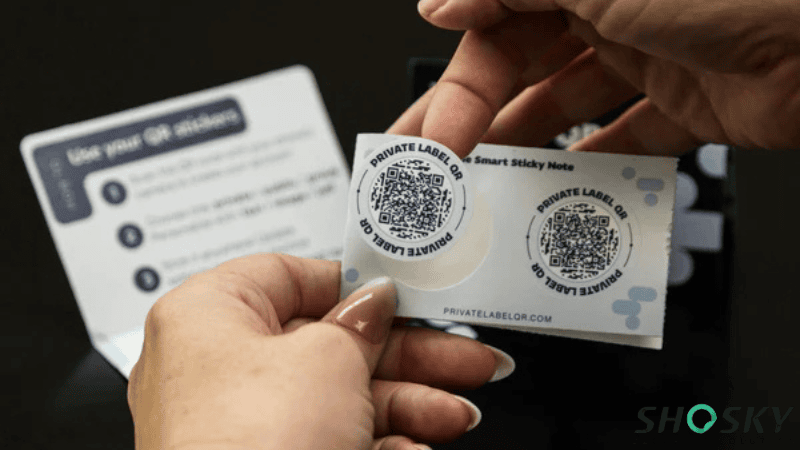
Serialized VOID labels integrate variable QR codes directly onto a destructible polyester or multi-layer paper substrate, typically between 38–75 microns thick, engineered to fragment or delaminate on any removal attempt. Each QR code is unique to a specific unit, batch, or shipment, generated at the point of manufacture and registered against a cloud record before the label ever reaches the packing line.
The moment a label is applied and scanned into the system, it becomes a live data node. From that point forward, every downstream scan at a receiving dock, inspection station, or retail point of sale updates the same record in real time.
To ensure automated scanners can read them perfectly on the warehouse floor, premium manufacturers print these QR codes at ANSI/ISO Grade A standards using highly durable resin ribbons.
If the label is peeled, the substrate self-destructs and leaves the VOID pattern on both the surface and the product, while the absence of a valid scan at the next expected checkpoint triggers an automatic flag in the tracking system. Procurement teams see not just that a label was tampered with, but exactly where in the transit route the breach occurred.
Operational Advantages
- Supply Chain Transparency: Detailed serialization enables precise tracking from the point of manufacture to the final destination, identifying potential diversion points.
- Tamper Evidence: Physical damage to the label serves as an immediate visual indicator of unauthorized handling.
Best for: Premium cosmetics, pharmaceutical packaging, and consumer electronics.
2. RFID and NFC Smart Security Seals
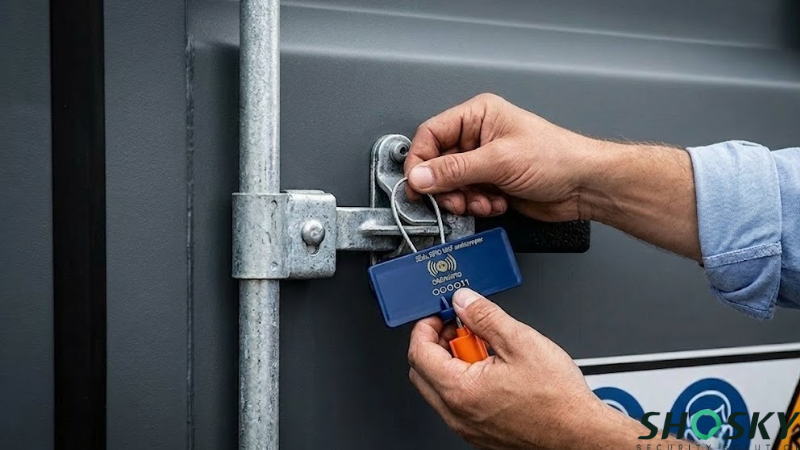
RFID and NFC smart security seals used in logistics operate at UHF frequencies in the 860–960 MHz range, with read distances of 1–10 meters depending on antenna design. NFC variants operate at 13.56 MHz, optimized for close-range authentication within 10 cm, making them well-suited for individual item verification at handover points.
Each seal contains an embedded IC chip wired through a frangible strap or conductive element integrated into the seal body. While the container remains closed, the circuit is complete, and the chip responds normally to reader queries. When the strap is cut or the seal is forced open, the circuit breaks permanently, and the chip either stops responding or returns a tamper flag.
At fixed reader points, portal antennas scan entire pallets without line-of-sight or manual handling. If a seal that was intact at origin arrives at a distribution center without a valid circuit-complete response, the system logs the discrepancy, cross-references the last clean read location, and alerts the logistics manager before the pallet is accepted into inventory.
For cross-border freight, many of these heavy-duty seals are engineered to meet strict ISO 17712 compliance.
Key Functional Capabilities
- Automated Tamper Detection: The system triggers real-time alerts when a seal or connection is broken, reducing the chance of missed incidents during high-volume processing.
- Efficiency in Transit: NFC and RFID technology support fast scanning of palletized shipments, helping reduce delays at checkpoints and improving flow in logistics operations.
Best for: Cross-border shipping containers, high-value transit, and automated bulk logistics.
3. Barcode Integrated Security Tape
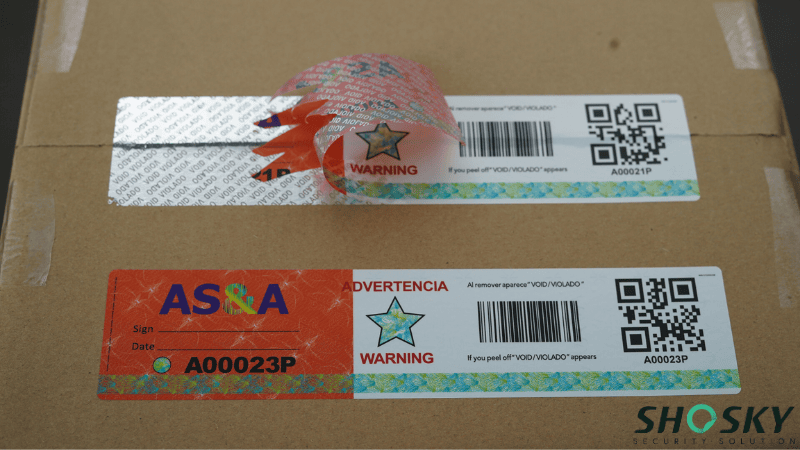
Barcode integrated security tape is manufactured with sequential unique barcodes printed at fixed intervals, typically every 100–150mm, onto a pressure-sensitive tamper-evident substrate engineered to tear, void, or leave a residue pattern on the carton surface if removal is attempted, making clean re-application impossible.
High-tack acrylic adhesives ensure this tape bonds permanently, even to low-surface-energy (LSE) recycled corrugated boxes.
At the point of application, the tape’s opening barcode sequence is scanned and registered against the shipment record in the WMS, creating a mathematical baseline tied to a specific carton, sequence, and timestamp. Every downstream scan checks incoming sequences against that baseline.
If a carton was opened and resealed with generic tape or a different roll, the mismatch flags the unit before it is accepted at the next distribution node. The tape integrates into existing scanning infrastructure without requiring new hardware or staff retraining, adding a security layer without disrupting throughput.
Core Security Applications
- Sequential Audit Trails: Each inch of tape serves as an extension of the shipping manifest, ensuring that any removal or replacement is mathematically detectable.
- Low-Friction Deployment: The application process mirrors standard packaging workflows, requiring no specialized machinery beyond existing scanning infrastructure.
Best for: E-commerce fulfillment centers, reverse logistics control, and pallet securing.
4. Security Deposit Bags with Digital Tear-Off Receipts
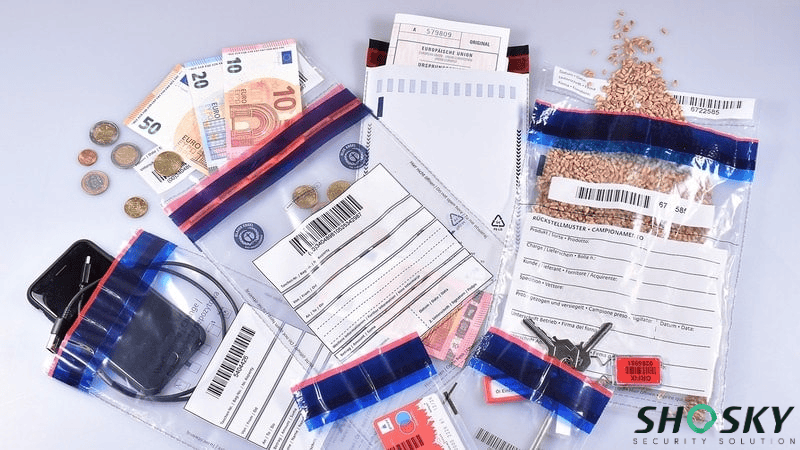
Security deposit bags are constructed from coextruded polyethylene film at 100–150 micron gauge, with a permanent heat seal that shows irreversible visual indicators, including color change or pattern reveal if exposed to heat, cold, or forced entry. The seal cannot be reactivated after opening.
Utilizing Level 4 security closures, these bags resist Freon (cold spray), heat guns, and moisture tampering.
Each bag carries a unique alphanumeric serial number on both the permanent seal strip and a perforated tear-off receipt, encoded in barcode or QR format on both sections for scanning into a digital custody log at the point of sealing. Every subsequent transfer is logged against that serial number, with handler identity and timestamp recorded at each step.
The tear-off receipt stays with the originating party while the bag moves through the chain. Any discrepancy between the physical serial number and the custody log surfaces immediately at reconciliation, without opening the bag or disturbing the contents.
Critical Security Features
- Streamlined Auditing: Serial numbers act as a digital reference, making it easier to track individual products through databases and improve record-keeping efficiency.
- Forensic Integrity: All documentation stays tied to each sealed bag, supporting reliable audit trails and stronger accountability in high-security environments.
Best for: Financial institutions, retail cash handling, and forensic evidence management.
The Financial ROI of Integrating Physical and Digital Security

Upgrading to phygital security is a revenue recovery strategy. The upfront cost of supply chain visibility solutions like tamper-evident labels and smart seals is a fraction of what businesses lose to cargo theft, counterfeiting, and compliance penalties each year. Here is how the numbers compare across key supply chain risk scenarios:
| Security Risk | Traditional Security Cost | Phygital Security Cost | Average Loss Prevented |
|---|---|---|---|
| Cargo theft per incident | $500 investigation + loss | $0.80 per seal | $8,000 avg. cargo value |
| Counterfeit product recall | $50,000+ per SKU | $0.15 per void label | Brand + regulatory penalty |
| Compliance audit failure | $10,000+ fine | Automated log (no cost) | Full fine avoidance |
| Grey market diversion | 15-40% revenue erosion | NFC tag + cloud sync | Full margin recovery |
The data collection by these integrated systems does more than prevent loss. It allows supply chain managers to analyze vulnerable transit routes, identify recurring risk points, and optimize the entire logistics network over time.
A joint study conducted by Auburn University and GS1 US reported that RFID technology can increase item-level inventory accuracy to more than 95%, helping warehouses and distribution centers reduce operational costs and eliminate manual counting errors.
Real-time visibility into inventory levels, shipment status, and production schedules turns security data into operational intelligence. That is the compounding benefit most companies miss when they only look at the unit cost of a seal or label.
FAQs
How does phygital protection transmit security alerts in real time?
When a physical seal or a serialized QR code is scanned, the logistics data updates the shipment status instantly. This process uses secure cloud integrations to send real-time alerts directly to your enterprise resource planning system if any physical anomaly is detected during transit.
What makes serialized VOID labels superior to standard security stickers?
Standard stickers can be peeled off cleanly or easily replaced with generic alternatives. Serialized VOID labels utilize a multi-layer destructible substrate that fractures completely upon removal, leaving an irreversible visual message, while the unique serialization prevents thieves from replacing the label.
Does barcode-integrated security tape disrupt standard fulfillment workflows?
Not at all. The application process mirrors standard carton sealing methods and requires no specialized warehouse machinery beyond your existing optical scanning infrastructure. It adds a powerful data tracking layer to your e-commerce operations without slowing down packaging throughput.
Upgrade Your Supply Chain with Shosky’s Solutions
Phygital asset protection is reshaping how supply chains handle security, traceability, and accountability. By combining tamper-evident hardware with connected digital tracking, it closes the gaps left by traditional packaging systems. Every scan, transfer, and breach becomes part of a verifiable record, giving businesses clearer visibility across the entire product journey.
As a premier manufacturing partner, Shosky Security brings this approach into practice through a wide range of tamper-evident solutions, including security seals, VOID labels, security tapes, and specialized tracking materials designed for logistics, banking, electronics, and high-value goods. Contact us today to discuss your needs!