
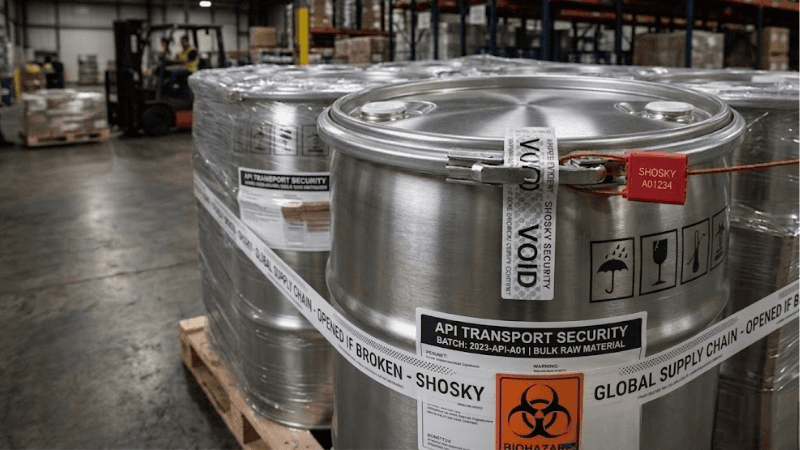
Global pharmaceutical supply chains depend heavily on the safe movement of raw materials long before any finished medicine is produced. Active Pharmaceutical Ingredient (API) transport often involves bulk drums passing through vast global logistics networks, where visibility naturally weakens, and physical risks increase.
A JAMA meta-analysis puts the global economic burden of falsified medicines at up to $200 billion, with supply chain tampering a significant contributing factor. Tamper-evident solutions, however, can help reduce API transport security gaps. Read on to see how they strengthen API transport security across global supply chains.
Why Pharma API Transport Security is the Weakest Link
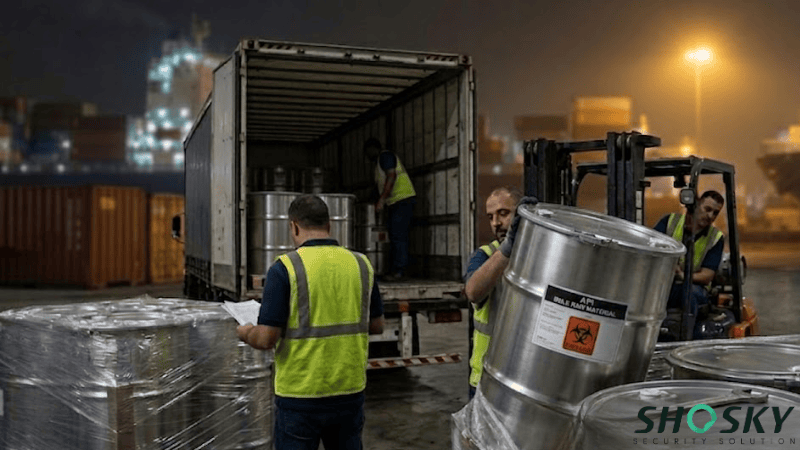
Raw API powders move very differently from finished, packaged medicines. They travel as highly valuable bulk chemical materials inside industrial drums across ocean freight or air cargo routes that can last for weeks.
Along the way, they pass through multiple logistics providers, third-party storage points, and customs checkpoints. Two main threats sit at the absolute center of this exposure:
- Adulteration: A fraction of the valuable API is removed and replaced with a visually similar filler, such as lactose or starch. The drum is covertly resealed, and the physical weight is adjusted to avoid suspicion during receiving checks.
- Skimming: High-value material is systematically taken out without any replacement. The container is closed again, leaving no visible sign of entry from the outside.
Bulk API protection sits at the very foundation of overall supply chain security. Quality issues already account for approximately 62% of drug shortages, demonstrating how early-stage logistics failures ripple through the entire healthcare system.
If contamination or tampering happens at the drum level, every subsequent quality check operates on compromised material. That turns the final pharmaceutical batch into a complete financial loss before production even begins.
Top Tamper Evident Solutions for Securing Bulk Chemical Containers
Bulk API containers require a multi-layered defense strategy across all physical access points. The following solutions combine mechanical restraints, tamper indicators, and pallet-level protection to secure these highly vulnerable logistics nodes against sophisticated supply chain interception.
1. Drum Security Seals for Mechanical Integrity
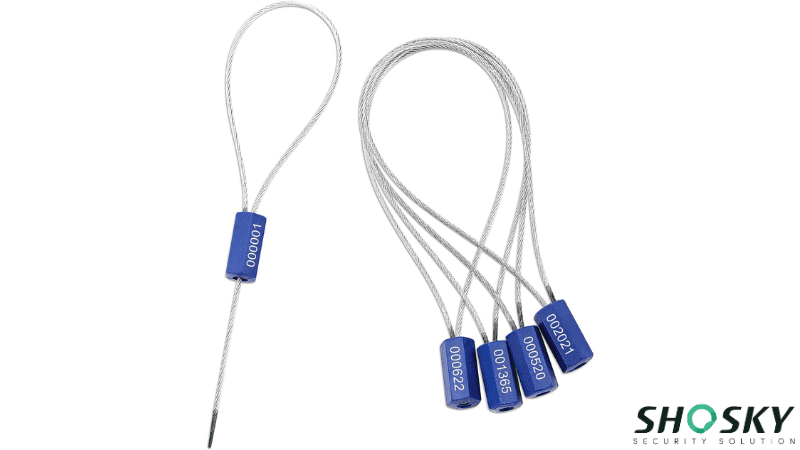
Metal locking rings on standard steel barrels create extreme exposure to covert bypass. Standard tools can easily manipulate the ring assembly, allowing access and reclosure without any visible disruption to the container.
To prevent a scenario where a container appears intact under routine inspection while the product is compromised, logistics teams must deploy serialized drum security seals.
These highly engineered seals mitigate physical risk through controlled mechanical restraint and strict traceable identification:
- Laser-Etched Serialization: Delivers a permanent, non-replicable identification number that prevents substitution with unauthorized generic seals.
- Fixed-Position Mechanical Locking: Restricts ring movement entirely and eliminates rotation without causing immediate, visible destruction to the seal body.
- Integrated Data Linkage: Connects each specific seal ID to a precise drum, batch record, and logistics manifest at the point of dispatch.
Seal verification at origin and destination creates a closed-loop authentication process. Any attempt to remove and replace the mechanical seal introduces a highly detectable discrepancy within the audit trail.
2. High-Tack Drum Security Labels for LSE Plastics
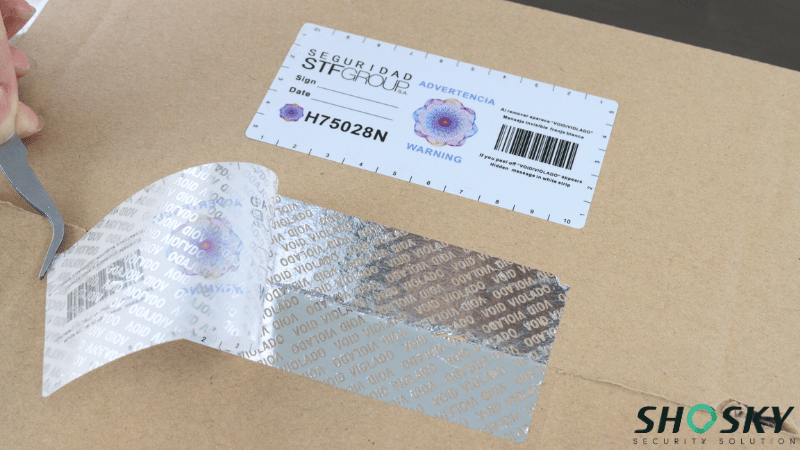
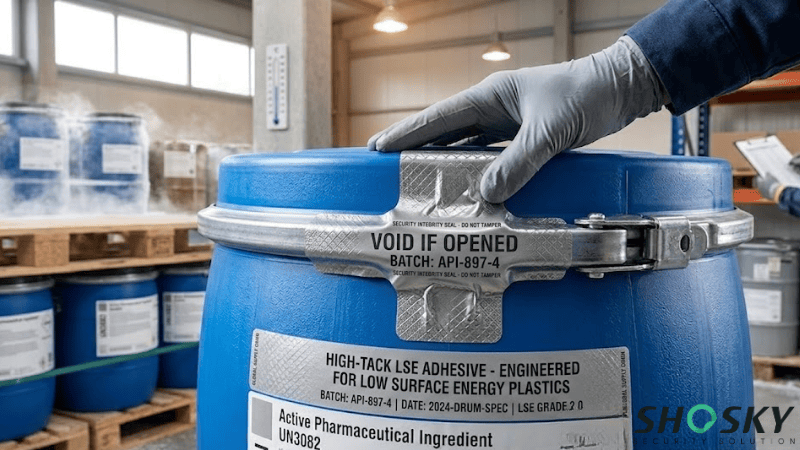
The interface between a drum lid and the barrel body introduces a secondary access vector that mechanical seals cannot fully cover. Standard adhesive labels fail completely in this area due to Low Surface Energy (LSE) materials like High-Density Polyethylene (HDPE), curved drum geometries, and harsh environmental exposure.
High-tack drum security labels eliminate this vulnerability through advanced material engineering and tamper-reactive face films:
- High Coat-Weight Adhesive: Delivers aggressive bonding performance specifically engineered for HDPE and other low-energy plastic chemical drums.
- Tamper-Reactive Face Film: Produces irreversible visual indicators, such as film fragmentation or a permanent “VOID” message activation upon attempted removal.
- Environmental Resilience: Maintains secure adhesion and structural integrity under severe temperature variations, heavy moisture, and chemical exposure during sea freight.
Applying these specialized labels across the lid seam or locking area converts a passive plastic surface into an active, verifiable inspection point.
3. Pallet Security Tape for Securing Consolidated Cargo
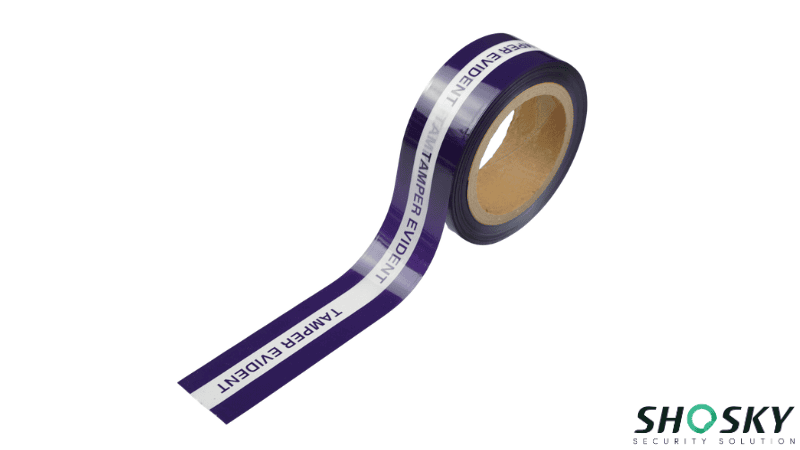
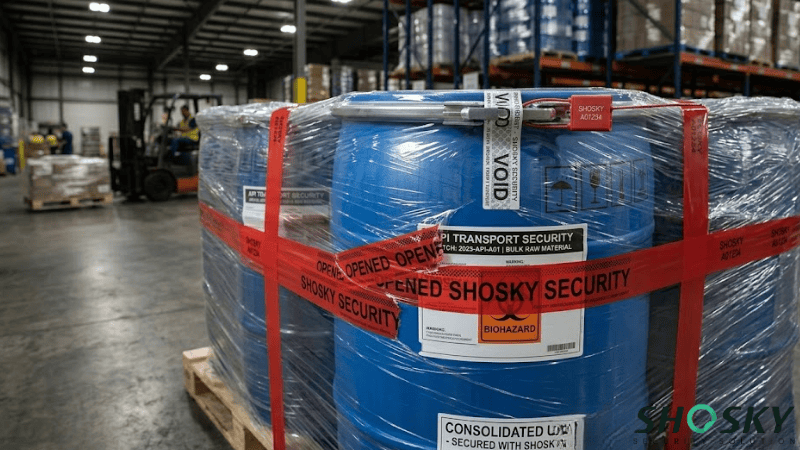
At the pallet level, consolidated API shipments introduce broader exposure to covert theft techniques. Methods such as “slash-and-wrap” allow thieves to perform partial cargo removal and rewrap the unit load without generating obvious external indicators. Standard clear stretch film provides zero resistance or traceability against this specific form of interference.
Wide-format, full-transfer pallet security tape establishes a highly visible and irreversible tamper layer across the entire unitized load:
- High-Adhesion Bonding: Grips aggressively to standard stretch film, ensuring that any precise cut or breach becomes immediately detectable at the surface level.
- Full-Transfer Messaging: Leaves a massive, permanent “OPENED” or “VOID” indication across the pallet wrap when interference occurs.
- Transit Durability: Retains high adhesion and vivid visual clarity across extreme temperature fluctuations and prolonged warehouse storage.
When combined with serialized drum seals and high-tack labels, pallet security tape completes a robust, multi-layered control system that physically secures access points at the drum, seam, and pallet levels.
Regulatory Alignment and Serialized Audit Trails for API Security
The physical security of seals, labels, and tape must be deeply integrated with digital documentation. Regulatory bodies like the US FDA and the EMA require a verifiable, unbroken chain of custody for all bulk APIs entering their jurisdictions.
Good Distribution Practice (GDP) requires pharmaceutical manufacturers to implement traceable controls that protect both physical shipments and the sensitive data linked to them. Serialized physical seals support this risk management strategy by providing the following integration benefits:
- Chain of Custody Verification: Mandates receiving facilities to verify physical drum seal serial numbers against digital shipping manifests to prevent undetected substitution.
- DSCSA Framework Alignment: Links physical tamper-evident identifiers directly to electronic Track and Trace systems to ensure total regulatory compliance.
- EBR and ERP Integration: Records unique seal serial numbers directly into Electronic Batch Records to maintain a seamless flow of secure communication across the supply chain.
- Origin-to-Destination Authentication: Creates a closed-loop audit trail where any physical tampering instantly flags a discrepancy in the digital logistics record.
Ultimately, integrating these serialized physical controls with digital tracking frameworks ensures absolute regulatory alignment. It empowers pharmaceutical brands to confidently prove an unbroken chain of custody, thereby avoiding costly regulatory audits and protecting the integrity of the final medical product.
API Transport Threat Matrix: Evaluating Vulnerabilities and Defense Layers
To maximize supply chain integrity, pharmaceutical procurement teams must shift from reactive purchasing to proactive threat modeling. Identifying specific operational blind spots allows logistics directors to deploy precise physical defenses.
The following diagnostic matrix maps API transport risks at critical handover points to their appropriate security solutions:
| Supply Chain Stage | Primary Attack Vector | Covert Detection Difficulty | Mandated Physical Defense |
|---|---|---|---|
| Dispatch and Origin Loading | Internal theft or unauthorized skimming before the bulk drum ever leaves the origin manufacturing facility. | High | Serialized Drum Seals physically locked and immediately linked to DSCSA electronic batch records. |
| Multi-Modal Transit Hubs | "Slash-and-wrap" pallet breaches during extended, unmonitored layovers at international air or sea freight terminals. | Extremely High | Full-Transfer Pallet Security Tape applied directly over the stretch film to prevent undetectable rewrapping. |
| Customs and Border Checks | Undocumented opening, unrecorded sampling, or improper resealing by third-party inspectors during transit. | Medium | High-Tack Drum Security Labels applied across the lid seam to force permanent, irreversible void activation. |
| Destination Receiving | Sophisticated adulteration where genuine API is replaced with chemical fillers (like lactose) and successfully resealed. | High | Multi-layered verification requiring the physical authentication of both mechanical seals and inner void labels before acceptance. |
This diagnostic approach transforms security from a basic compliance checkbox into a targeted risk mitigation strategy. Mapping physical defenses to known vulnerabilities ensures any attempt at tampering or adulteration becomes instantly visible before the compromised API enters the final manufacturing facility.
Expert Tip from Shosky Security: The Cold Chain Adhesive Requirement
Many modern APIs, particularly those used for biologics and advanced therapies, require strict cold chain transport. Procurement teams must be aware that standard security labels will freeze, lose their tack, and simply fall off HDPE drums in sub-zero air freight environments. Always specify tamper-evident labels engineered with “Deep Freeze Adhesives” to ensure your security signals survive the extreme temperatures of pharmaceutical cold chain logistics.
FAQs
Q1: What is the difference between an API in pharma and software?
In the pharmaceutical industry, API stands for Active Pharmaceutical Ingredient, which is the biologically active component of a drug. In software, it stands for Application Programming Interface. Transport security in pharma deals entirely with securing the physical bulk chemicals during global logistics.
Q2: Why do standard security labels peel off chemical drums?
Most bulk chemical drums are manufactured from High-Density Polyethylene (HDPE), which is a Low Surface Energy (LSE) plastic. Standard adhesives cannot form a strong chemical bond with LSE surfaces. High-tack, high-coat-weight acrylic adhesives are required to secure these industrial drums permanently.
Q3: How does pallet security tape prevent slash-and-wrap theft?
Slash-and-wrap theft occurs when a thief cuts the clear stretch film to steal a drum, then simply rewraps the pallet with new clear film to hide the theft. Pallet security tape features custom branding and tamper-evident void technology. If the tape is cut or peeled, it leaves a permanent warning message, making the theft immediately visible to receiving inspectors.
Q4: Do drum seals help with DSCSA compliance?
Yes. The Drug Supply Chain Security Act (DSCSA) requires strict tracking and tracing of pharmaceutical products. Serialized tamper-evident drum seals provide the unique, physical identification numbers necessary to link a bulk chemical container to its digital electronic batch record, ensuring an unbroken chain of custody.
Reduce Risk in API Transport Security With Shosky’s Solutions
Weak points in API transport security often appear during the handling and transfer stages. Tamper-evident solutions help close these gaps by making unauthorized access visible across the supply chain. At Shosky Security, we offer reliable tamper-evident solutions for API protection.
This includes drum seals, labels, and pallet protection solutions for better control over chemical materials during transportation. These solutions also help maintain compliance and reduce risk across logistics networks. Contact us to request a sample kit or to discuss a customized security program for your global supply chain needs.