
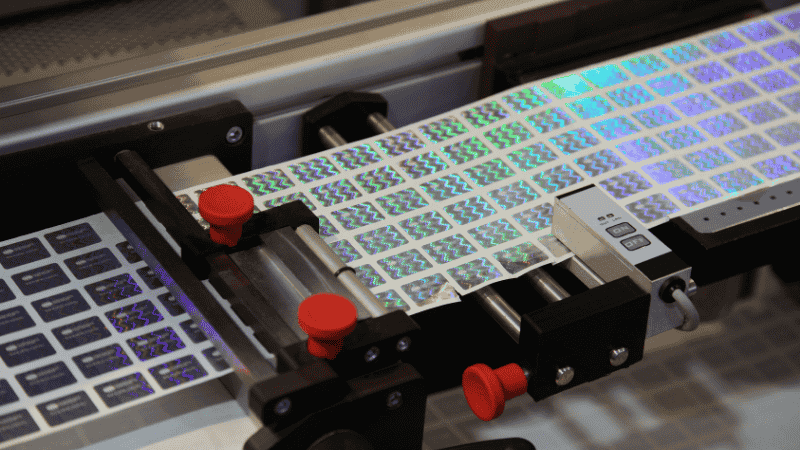
According to the International Chamber of Commerce, counterfeit goods drain over two trillion dollars from the global economy annually. As fraudsters master standard packaging replication, traditional barcodes and printed labels are no longer enough to protect your revenue.
Businesses must adopt advanced optical defenses that are physically impossible to copy using commercial printers. Hologram sticker printing remains the most effective, mathematically secure method to verify product authenticity, secure warranties, and defeat the grey market. This technical guide breaks down exactly how commercial hologram sticker printing works and how procurement teams can specify the right security labels for their brand.
What is Hologram Sticker Printing?
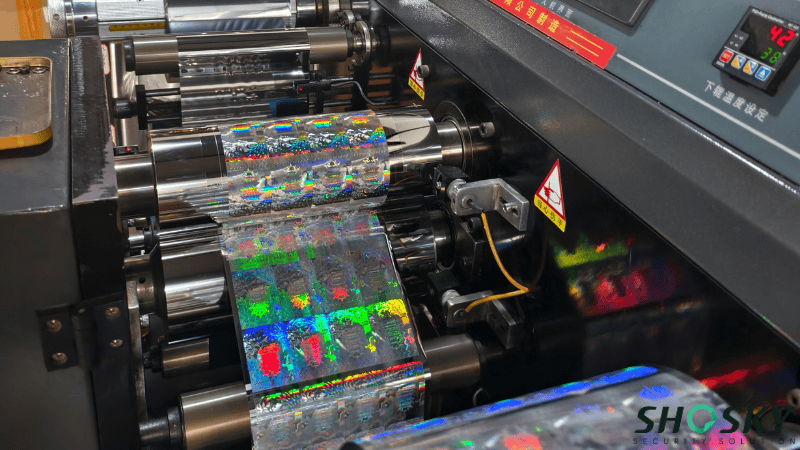
Hologram sticker printing is the specialized manufacturing process of creating highly secure, light-diffracting adhesive labels. These labels function as Optical Variable Devices (OVDs). This means their visual appearance changes drastically depending on the viewing angle and ambient lighting conditions.
Unlike regular printed stickers that use traditional CMYK ink droplets, true holographic stickers rely on the physics of light diffraction. By utilizing these optical principles, commercial hologram sticker printing delivers three distinct structural advantages for brand protection:
- Nanometer-Level Security: Micro-structured patterns create a 3D shimmer that standard ink cannot replicate.
- Environmental Durability: The labels are waterproof, scratch-resistant, and chemically resilient in harsh transit conditions.
- Forensic Integration: They seamlessly embed covert tracking features like micro-text and laser cryptograms.
These functional benefits make them an absolute necessity for industries such as consumer electronics, pharmaceuticals, and automotive parts, where product security and supply chain traceability are critical.
5 Methods Used in the Hologram Printing Process
A common misconception in the procurement world is that holograms are printed using standard digital ink printers. In reality, authentic hologram sticker printing involves complex optical engineering and micro-embossing.
This level of technical sophistication requires multi-million dollar machinery, which is exactly what keeps counterfeiters at bay.
To help packaging engineers understand what they are buying, we have detailed the five core manufacturing steps used in true security holography:
1. Optical Master Origination
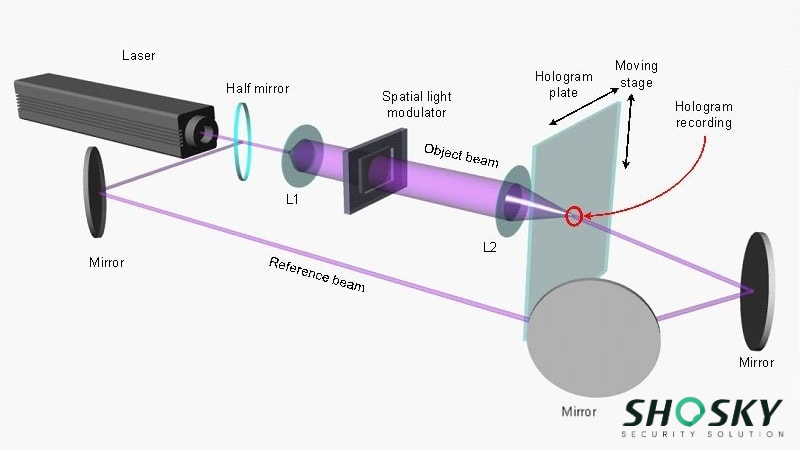
The process begins in a strict cleanroom laboratory where lasers or electron beam lithography systems are used to record a highly intricate optical design onto a photosensitive glass master plate. This step creates the microscopic nano-gratings that will eventually bend the light and create the 3D holographic effect.
The resolution of this laser etching can exceed the equivalent of 120,000 dots per inch (DPI), creating a master plate that is mathematically secure and entirely unique to your specific brand.
2. Nickel Electroforming
Once the glass master is complete, it is submerged in a specialized chemical electroforming bath.
This process grows a durable layer of nickel directly over the microscopic grooves of the glass master, creating a robust metal “shim” or stamping plate. This nickel shim acts as the precise industrial mold that will be used to mass-produce the holographic pattern without losing any optical fidelity or sharpness.
3. Thermal Micro-Embossing
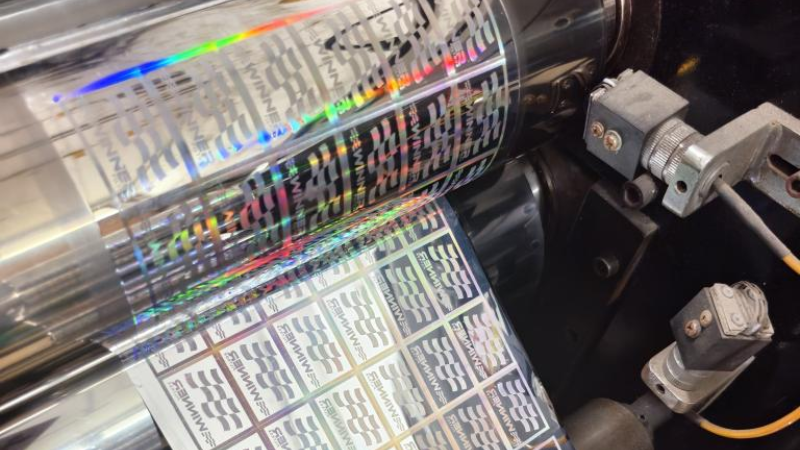
This is the core mechanical step of the hologram sticker printing process. The nickel shim is mounted onto a high-speed rotary embossing machine. A roll of ultra-thin, heat-sensitive PET (Polyethylene Terephthalate) plastic film is fed through the machine.
Under intense heat and immense mechanical pressure, the nickel shim presses the microscopic holographic patterns directly into the surface of the plastic film at extremely high speeds.
4. Vacuum Metallization
After the optical pattern is successfully embossed into the transparent plastic, the film is placed inside a massive vacuum chamber. A microscopic layer of aluminum vapor is deposited onto the embossed surface.
This highly reflective metallic backing acts as a mirror, allowing ambient light to bounce back through the embossed patterns to reveal the vibrant, shifting rainbow colors to the human eye.
5. Tamper-Evident Coating and Die-Cutting
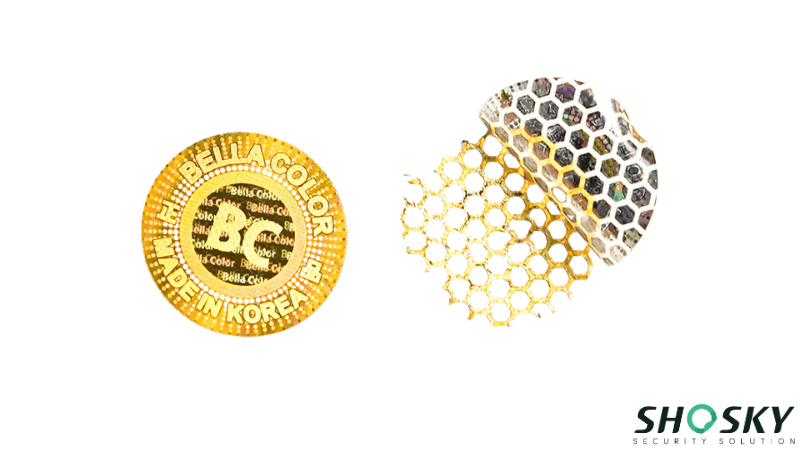
In the final manufacturing stage, a specialized release coating and a high-tack acrylic adhesive are applied to the back of the metallized film. This is where security features like “VOID” or honeycomb patterns are chemically integrated.
The master roll is then laminated with a protective release liner and run through precision rotary die-cutting machines to create the final individual stickers or continuous rolls.
By utilizing these five advanced optical engineering steps, source factories ensure that the final security labels cannot be scanned, photocopied, or replicated by unauthorized third parties.
How to Design a Hologram Sticker for Security Printing
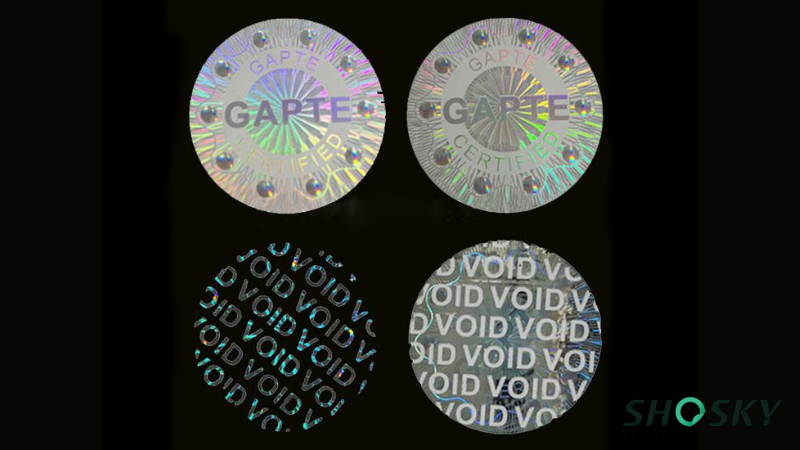
Designing a holographic sticker for commercial security requires a completely different approach than standard graphic design. You are not designing with flat ink colors; you are designing with light, reflection, and physical depth.
To ensure your final product is both visually striking and secure against unauthorized duplication, procurement teams should follow these four technical design steps:
Step 1: Define Your Overt Security Features
The first step in designing a security hologram is choosing the visual elements that a consumer can verify instantly with the naked eye. Instead of flat graphics, you must design with depth.
This includes incorporating intricate Guilloche patterns (complex, interwoven geometric lines), kinetic movement where elements appear to rotate as the sticker is tilted, and true-color holographic imagery that perfectly highlights your primary brand logo.
Step 2: Incorporate Covert and Forensic Elements
To defeat professional counterfeiters, your design must include features that cannot be seen easily. You should integrate micro-text (text so microscopic it requires a jeweler’s loupe or magnifying glass to read) or hidden laser-readable cryptograms.
These advanced forensic elements allow your supply chain inspectors, brand protection officers, and customs officials to verify authenticity in the field using specialized proprietary tools.
Step 3: Choose Your Holographic Base and Finish
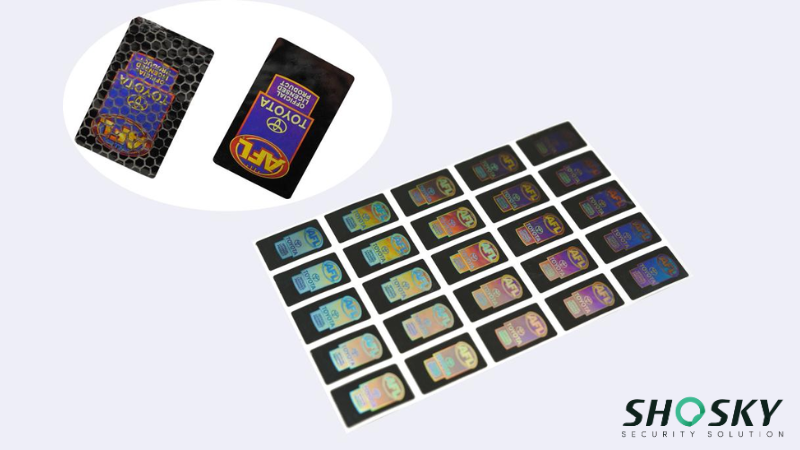
Beyond the optical design, the physical material choice is crucial. You must select the base foil that matches your specific packaging substrate. Common finishes used in hologram sticker printing include:
- Standard Silver or Gold Metallized Foil: Provides maximum reflectivity and contrast for high-security applications on dark packaging.
- Transparent Holographic Film: Allows the underlying product packaging, brand colors, or serial barcodes to show through while still displaying the security shimmer on top.
- Demetallized Holograms: Parts of the metal layer are chemically washed away to create precise transparent windows within the sticker, offering a highly premium look that is exceedingly difficult to replicate.
Step 4: Integrate the Tamper-Evident Mechanism
Finally, you must design how the sticker behaves if a thief tries to remove or transfer it. Packaging engineers typically choose from these three strict security mechanisms:
- Total-Transfer VOID: Leaves a permanent, sticky warning residue directly on the cardboard or product surface.
- Non-Transfer VOID: Destroys the hologram’s optical layer but leaves the underlying expensive product surface perfectly clean.
- Destructible Vinyl Base: Causes the entire sticker to shatter into tiny, unpeelable fragments upon picking.
By strictly following these four structural design principles, packaging engineers can create a highly sophisticated holographic sticker that perfectly balances premium marketing aesthetics with unbreakable supply chain security.
Strategic Applications of Hologram Sticker Printing
Holographic stickers offer a dynamic way to secure global supply chains and elevate product presentation. Their unique optical properties are versatile and deeply integrated into various industrial workflows.
These high-tech labels are actively deployed across strict regulatory environments to achieve the following critical business goals:
Brand Protection and Electronics Warranty Security
Holographic stickers serve as the ultimate deterrent against unauthorized replication and warranty fraud. For high-value goods like luxury fashion, computer components, and smartphones, serialized holograms provide unique identifiers.
Manufacturers place these labels over screw holes, hard drive enclosures, or device seams. This allows repair technicians to instantly verify if a device was opened by an unauthorized third party, protecting the company from fraudulent warranty claims and unauthorized repairs.
Pharmaceutical Compliance and Safety
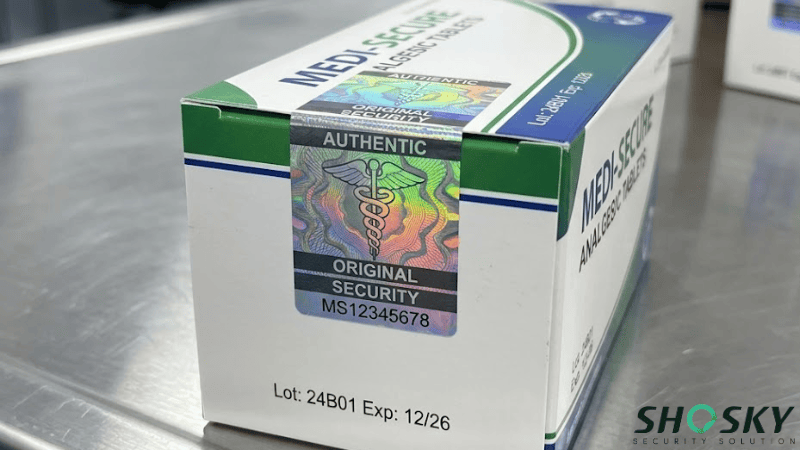
In the medical and pharmaceutical sectors, the integrity of packaging is quite literally a matter of life and death. Holographic seals integrated with destructible features prevent product tampering and grey market diversion. These tamper-evident seals guarantee the integrity of over-the-counter medications, prescription bottles, and testing kits.
Furthermore, combining holograms with serialized barcodes helps pharmaceutical companies comply with strict global track-and-trace mandates, such as the DSCSA in the United States or the FMD in Europe.
Product Premiumization and Government Tax Stamps
Government agencies utilize hologram sticker printing to create highly secure tax stamps for alcohol and tobacco products, ensuring proper revenue collection and deterring massive smuggling operations.
Similarly, commercial brands use these shimmering labels on limited-edition merchandise, sports memorabilia, or premium cosmetics. The holographic effect significantly enhances perceived value, signaling exclusivity and absolute authenticity to discerning buyers who are willing to pay a premium.
By integrating these optical solutions into their packaging operations, organizations can actively reduce revenue loss while reinforcing absolute consumer trust and brand loyalty.
Advanced Customization Options for Your Security Stickers
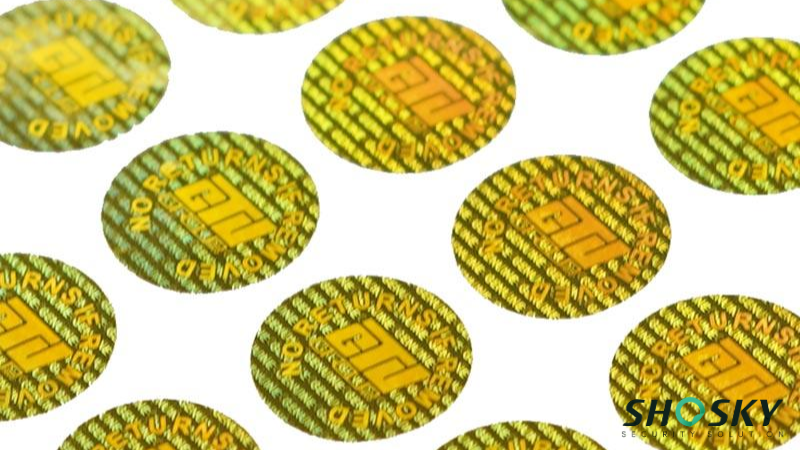
Modern hologram sticker printing is highly versatile, offering deep customization to suit very specific industrial requirements. A basic shiny sticker is no longer enough for high-risk supply chains.
From covert tracking codes to customized chemical adhesives, buyers can specify exactly how their labels perform by choosing from the following functional options:
| Customization Category | Available Options |
|---|---|
| Shape & Size | Custom die-cutting for intricate contours and unique forms. |
| Holographic Material & Pattern | Classic rainbow, subtle pillar, dynamic lens, cracked ice, glitter, or custom patterns. |
| Adhesive Type | Permanent, removable, strong bond/aggressive, or cold temperature formulations. |
| Security Features | Destructible materials, VOID messages, serialization, variable data, micro-text, hidden images, security cuts. |
| Print Overlays & Inks | Opaque inks, transparent inks, matte varnish, or other specialty ink applications. |
| Special Effects | UV ink, metallic inks, glow-in-the-dark elements, or thermochromic inks. |
By strategically combining these advanced customization variables within the table above, procurement teams can engineer a bespoke holographic sticker that solves their exact tracking, branding, and anti-tampering challenges simultaneously.
How to Order Custom Hologram Stickers for Your Brand
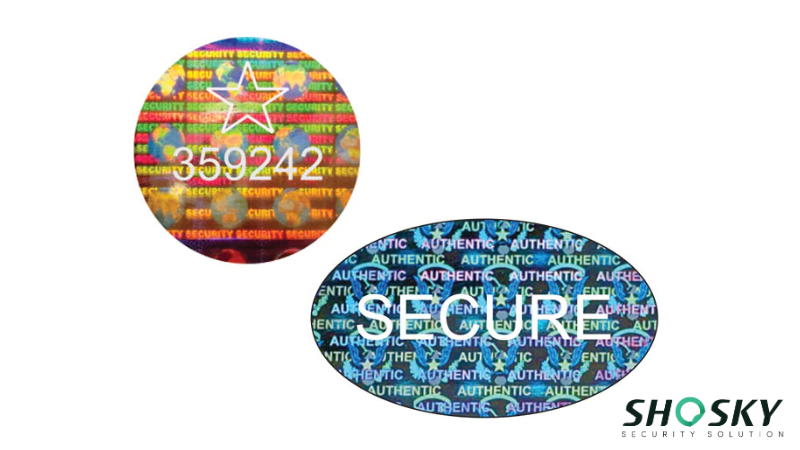
Unlike ordering standard office supplies, procuring custom security holograms requires a structured technical process to guarantee absolute security. Counterfeiters often try to order fake labels from unverified suppliers, so legitimate factories have strict vetting procedures.
Here is the professional workflow you should expect when partnering with a legitimate source manufacturer:
- Technical Consultation: Discuss your specific application surface (like corrugated cardboard, metal, or glass), your required security level, and whether you need tamper-evident adhesives designed for extreme cold or heat.
- Artwork Submission and Master Design: Provide your vector logo files. The manufacturer’s optical engineers will translate your flat 2D logo into a multi-layered 3D holographic design proof for your exact approval.
- Master Origination and Security Protocols: Once approved, the highly secure optical glass master plate is created in a cleanroom environment. Reputable factories have strict security protocols to ensure these master plates are never copied, stolen, or reused for other clients.
- Mass Production and Lead Times: The factory proceeds with micro-embossing, adhesive coating, and die-cutting. Always confirm lead times with your account manager, as custom master origination typically requires slightly more processing time than standard commercial ink printing.
By understanding this specialized manufacturing workflow, supply chain managers can confidently procure high-quality hologram stickers that arrive on schedule and perform flawlessly in the field.
FAQs
Q1: Can a custom hologram sticker be copied or scanned by a printer?
No. True holograms are created via nano-scale micro-embossing, not standard ink. A standard scanner or high-end digital printer will only capture a flat, gray image. Counterfeiters cannot copy a hologram without possessing the expensive original Master Shim.
Q2: Can I print barcodes or black text on a holographic sticker?
Yes. While the holographic effect itself cannot be “printed,” manufacturers use secondary UV or flexographic printing to apply solid, high-contrast inks (like black or dark blue) directly on top of the holographic foil to display serial numbers, barcodes, and QR codes.
Q3: What is the difference between a standard hologram and a tamper-evident hologram?
A standard hologram is used purely for aesthetics and brand authentication; it can be peeled off cleanly. A tamper-evident hologram features a specialized adhesive layer (like VOID or honeycomb) that physically destroys the hologram or leaves a warning message if someone attempts to remove it.
Q4: Do hologram stickers work on curved surfaces or small vials?
Yes, but you must specify this during the ordering process. For small radii, such as lip balm tubes or medical vials, manufacturers use a much thinner PET film and a highly aggressive acrylic adhesive to prevent the edges of the sticker from “flagging” or lifting up.
Conclusion
In conclusion, holographic stickers are not just a trendy visual tool—they represent a powerful branding and marketing strategy that can enhance your product’s appeal and increase consumer engagement! With customization options ranging from shapes and sizes to unique effects, hologram sticker printing provides limitless opportunities for brands to express their identity in a creative and memorable way. So, ready to start creating custom holographic stickers?
Reach out for Professional Holographic Sticker Printing From Shosky!
Are you ready to secure your supply chain? At Shosky Security, we ensure your stickers look incredible and provide top-notch security. Whether you need custom labels, holographic stickers, or anti-counterfeit seals, we offer comprehensive solutions for your brand protection. Contact us today to discuss your needs!