
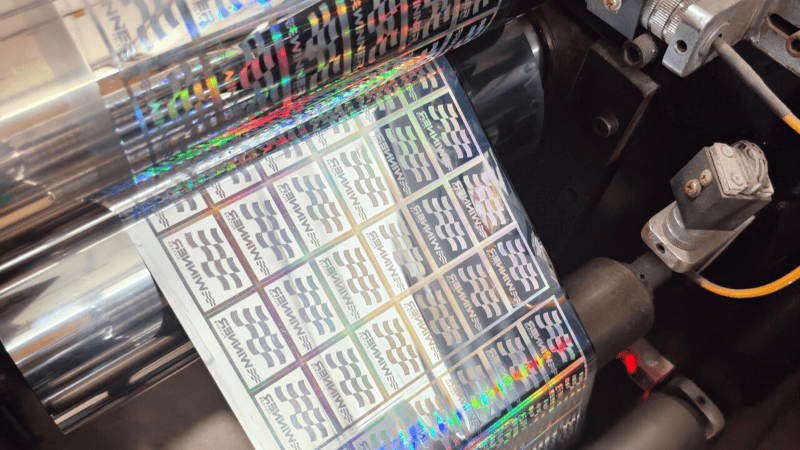
Brand protection teams evaluating UV ink, holographic foil, and color-shifting ink are often comparing three technologies that don’t actually compete for the same job. UV ink is invisible to the naked eye and only reveals itself under UV light, which puts it firmly in the covert category. Holographic foil and color-shifting ink, by contrast, are both designed to be checked instantly by anyone with no tools at all; they’re overt features.
Treating all three as interchangeable options on the same shortlist is where many packaging security programs go wrong before they even reach a supplier quote. This guide compares all three head-to-head on verification requirements, counterfeit resistance, cost, durability, and substrate fit, and explains why the right answer for most brands isn’t to pick one; it’s to layer an overt feature with a covert one.
Covert vs. Overt: Where Each Authentication Technology Actually Sits
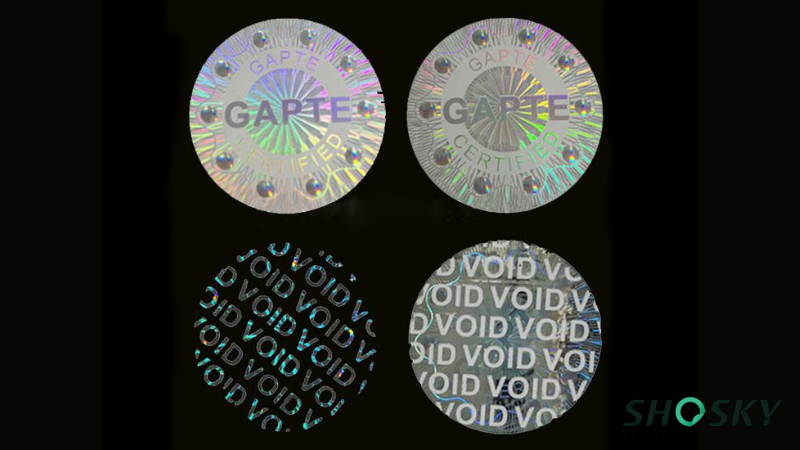
The distinction matters more than any single comparison metric below, because it determines who can actually use the feature. Authentication features fall into two groups based on how they get checked, and the 3 technologies in this guide land on opposite sides of that line.
- Overt features are checked by eye or touch without equipment, so a consumer, a retail clerk, or a customs officer with no training can run a check on the spot. Holographic foil and color-shifting ink both belong here.
- Covert features require a specific tool or specialist knowledge, which makes them far harder for a counterfeiter to detect and copy in the first place, but useless to anyone at a retail shelf without that tool in hand. UV ink belongs here.
Industry guidance on anti-counterfeiting technology consistently places holograms and color-shifting inks in the overt category, and UV (and IR) inks in the covert category, precisely because of this verification gap. That single distinction is the reason brand protection programs rarely rely on just one of these three technologies.
Not Sure Whether Your Product Needs Covert, Overt, or Both?
Start With A Low Minimum Order Quantity
UV Ink: Covert Verification That Requires a UV Light Source
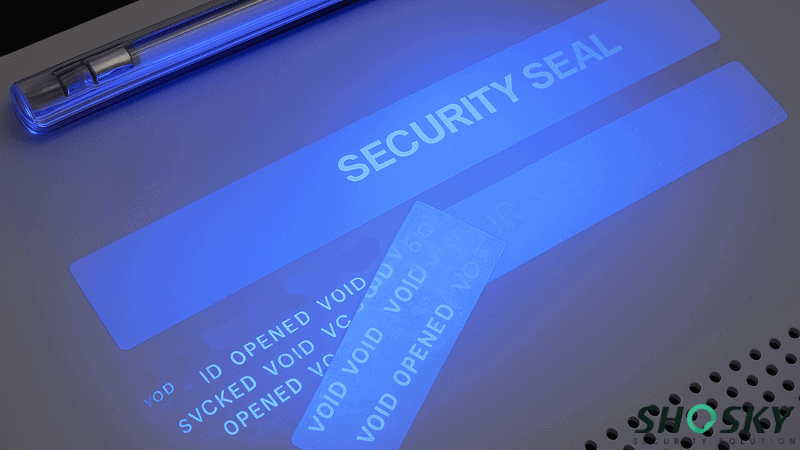
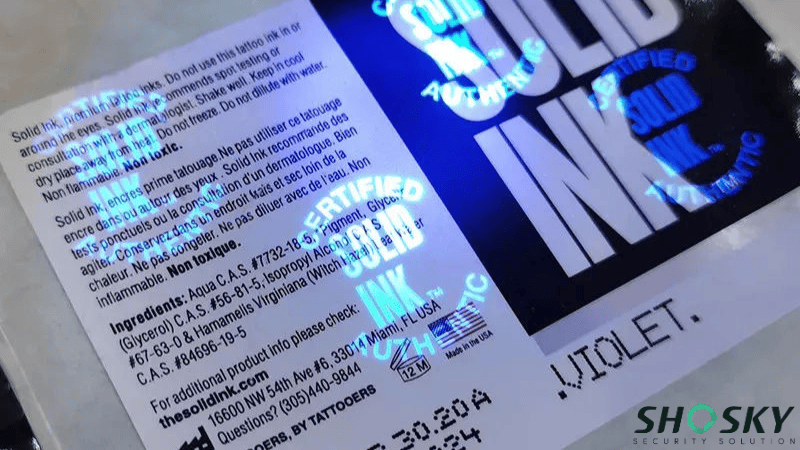
UV security ink is printed invisibly under normal lighting and fluoresces only when exposed to ultraviolet light, either long-wave or short-wave, depending on the ink formulation. Because the image or text is completely invisible until illuminated, it functions as a hidden authentication layer rather than a consumer-facing deterrent.
- Verification tool needed: A UV lamp, either handheld or built into inspection equipment. No verification is possible under normal light.
- Counterfeit resistance: High for casual counterfeiters, since the feature isn’t visible to copy in the first place. A sophisticated counterfeiter with access to the same ink chemistry and printing process can still replicate it, which is why formulation control and supplier vetting matter as much as the ink itself.
- Cost: Generally the lowest of the three, since UV ink can be applied using standard flexographic, offset, or screen printing equipment with only a formulation change, no specialized foil stamping or optical layering required.
- Durability: Good on most substrates, though light fastness and chemical resistance vary significantly by formulation; always confirm a specific ink’s resistance to the storage and handling conditions your product will actually face.
- Substrate fit: Broad. UV ink prints onto paper, film, and most flexible packaging substrates without the surface constraints that foil-based features run into.
In short, UV ink trades consumer visibility for low cost and broad substrate compatibility. It works best as a quiet backstop that quality teams and investigators can check on demand, not as the feature a shopper is meant to notice. That is why it is rarely used alone and is usually paired with a visible feature on the same pack.
Holographic Foil: Overt Verification Consumers Can Check Instantly
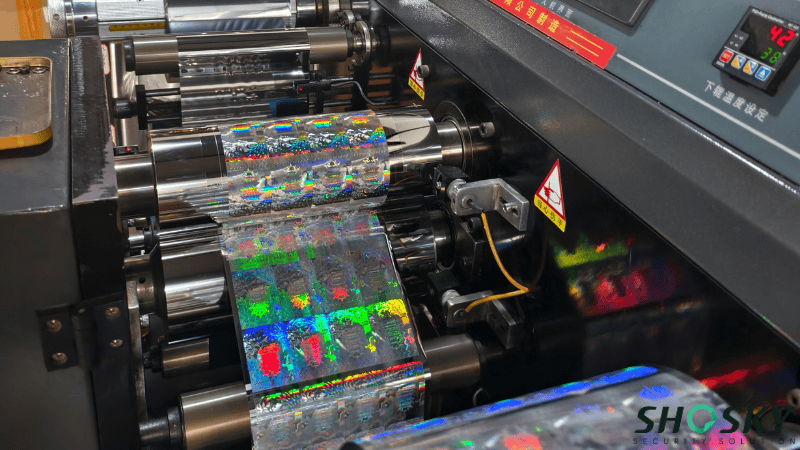
The shift from a hidden feature to a visible one is the entire point of the next two technologies, and holographic foil is the most recognizable of the pair. A hologram displays a complex, three-dimensional image or pattern that shifts as the viewing angle changes, and it’s produced through a photographic diffraction process that standard color printers, scanners, and cameras cannot reproduce.
- Verification tool needed: None for a basic check; consumers verify by tilting the product and observing the expected visual shift against their memory or a reference sample. More complex hologram types (dot-matrix, multi-layer 2D/3D) require closer inspection to catch fine detail differences.
- Counterfeit resistance: Historically very high, since replicating the diffraction structure requires specialized origination equipment. That resistance has eroded over the past decade as counterfeiters gained access to convincing hologram-replication capability, which is why brand protection guidance increasingly treats basic holograms as a deterrent layer rather than a standalone security guarantee.
- Cost: Moderate to high, driven by origination tooling costs (the master diffraction pattern) plus the hot-stamping or transfer process needed to apply foil to packaging.
- Durability: Strong once applied correctly, foils are generally abrasion- and moisture-resistant, though the bond to the substrate is what determines whether the feature survives handling without lifting or cracking.
- Substrate fit: Works best on relatively flat, rigid, or semi-rigid surfaces, cartons, rigid boxes, labels. Curved or highly flexible substrates make consistent foil application harder to control.
Holographic foil earns its place where a premium, instantly recognizable look matters and the substrate is sufficiently flat to accommodate a clean foil transfer. Its main limitation is that verification is comparative: a well-made copy can still fool a shopper who has no genuine sample to check it against, so foil deters casual copying better than it stops organized counterfeiting.
Color-Shifting Ink: Overt Verification Without the Foil Application Step
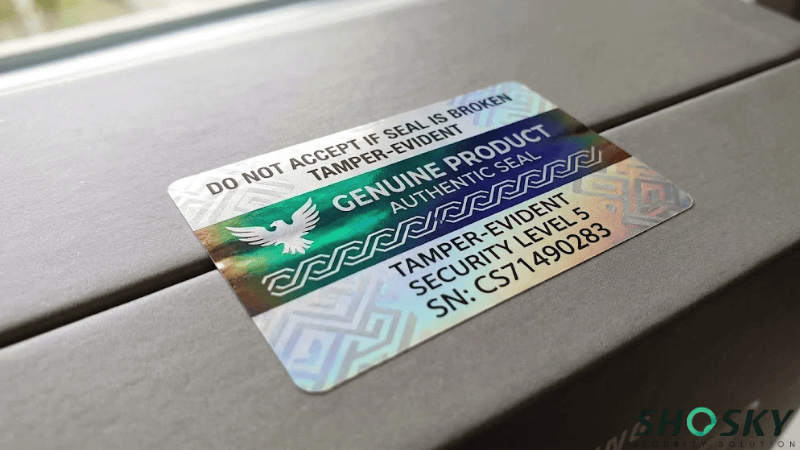
Color-shifting ink, sometimes called optically variable ink (OVI), achieves a similar consumer-facing effect to holographic foil through a completely different mechanism: the ink itself contains pigments that display two or more distinct colors depending on the viewing angle, rather than relying on a diffraction pattern.
- Verification tool needed: None. A consumer tilts the printed area and checks that the expected color transition occurs.
- Counterfeit resistance: High. The specialized pigments used in genuine color-shifting ink are tightly controlled by a small number of suppliers, and access is typically restricted through end-use agreements, which limits how easily a counterfeiter can source the real material even if they understand the effect.
- Cost: Typically the highest per-unit cost of the three, the specialty pigments themselves carry a significant premium over standard or even UV ink formulations.
- Durability: Generally strong, since it’s a printed ink layer rather than an applied foil, it avoids the lifting or cracking risk that foil-substrate bonding can introduce.
- Substrate fit: Broader than foil, since it’s applied through standard printing processes rather than a separate stamping step, making it more compatible with curved or flexible packaging.
Color-shifting ink suits programs that want a consumer-checkable feature on curved or flexible packaging without adding a foil stamping step. The price of that flexibility is the specialty pigment premium, so it tends to make the most sense on higher-value products where the added per-unit cost is small relative to the product’s price.
Side-by-Side Comparison: UV Ink, Holographic Foil, and Color-Shifting Ink
Lining the three up against the same criteria makes the trade-offs concrete. Cost and durability numbers vary by supplier and formulation, so treat the table as a directional comparison to guide supplier conversations, not a fixed quote.
| Criteria | UV Ink | Holographic Foil | Color-Shifting Ink |
|---|---|---|---|
| Category | Covert | Overt | Overt |
| Verification tool | UV light source required | None, visual tilt check | None, visual tilt check |
| Who can verify | Inspectors, investigators with equipment | Anyone at point of sale | Anyone at point of sale |
| Relative cost | Lowest | Moderate to high | Highest |
| Application method | Standard printing, formulation change | Hot stamping / foil transfer | Standard printing, specialty pigment |
| Best substrate fit | Broad, paper, film, flexible packaging | Flat, rigid or semi-rigid surfaces | Broad, including curved surfaces |
| Main weakness | Invisible to consumers; needs trained inspectors | Application constraints; increasingly replicated | Highest cost; pigment supply is tightly gated |
Read across the rows, and a pattern emerges: the cheapest and broadest option, UV ink, is the one consumers can’t see, while the two features consumers can check each carry a cost or application trade-off. No column wins on every row, which is why the more useful question is less “which one should we pick” and more “how should we combine them.”
Why Layered Authentication Usually Beats Picking Just One
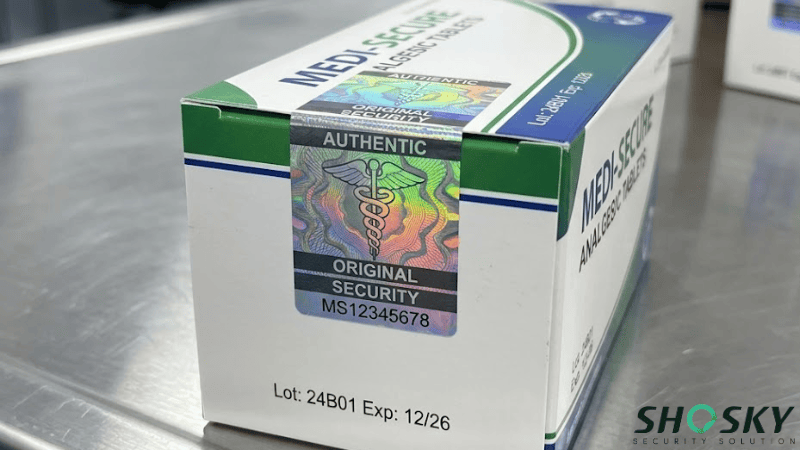
The comparison above makes a single-technology decision look straightforward on paper, but brand protection programs that rely on one feature alone tend to have a predictable failure mode: an overt feature reassures a consumer but can eventually be copied well enough to fool them, while a covert feature stops a casual counterfeiter cold but is invisible to the person actually holding the product at checkout.
A common and effective pattern layers an overt feature, holographic foil or color-shifting ink, as the first, visible deterrent, with UV ink as a second, hidden layer for investigators, customs officials, or your own quality team to check when something looks off. A counterfeiter who successfully replicates the visible hologram still has no way of knowing the covert UV layer exists, let alone matching its formulation.
Layering only works if the covert layer stays covert. Keep its location and expected UV response out of consumer-facing instructions, and share them only with the inspectors and partners who need them. Some brands use the overt feature as a decoy: counterfeiters copy the obvious hologram, while the hidden mark exposes the fake later during inspection.
Because these features are added during printing and converting, they can be applied to the same product as mechanical tamper evidence, for example, on customizable security tape that combines logos and serial numbers with ink-based layers.
FAQs
Q1: Can UV security ink and holographic foil be applied together on standard security tape?
Yes, combining covert UV security ink with overt holographic foil is a recommended security practice. The visible hologram serves as an immediate deterrent to consumers, while the hidden UV ink layer provides indisputable forensic evidence for field inspection teams.
Q2: Which authentication technology provides the highest resistance against organized counterfeiting?
Under ISO 12931 standards, no single feature is completely unbreakable. Proprietary color-shifting pigments combined with covert UV taggants offer maximum resistance because sourcing restricted raw materials and detecting hidden fluorescent indicators pose double technical barriers.
Q3: How does color-shifting ink differ chemically from standard holographic hot-stamping foil?
Color-shifting ink utilizes multi-layer optical interference pigment flakes suspended in a liquid ink vehicle. Holographic foil relies on microscopic surface diffraction patterns transferred to substrates using thermal-pressure hot-stamping equipment.
Q4: Does printing invisible UV security ink require dedicated press equipment?
No specialized machinery is required. UV security ink runs directly on conventional flexographic, offset, or rotary screen printing presses. The specialized security chemistry resides entirely within the ink formulation rather than requiring press modifications.
Build Your Multi-Layered Packaging Security Strategy
Selecting the ideal anti-counterfeiting technology requires balancing visual consumer verification against rigorous covert laboratory detection. Relying on basic single-layer packaging security leaves high-value physical products highly vulnerable to organized illicit replication.
Protect your brand assets with custom-engineered security packaging. Contact the technical printing specialists at Shosky Security today to review your substrate specifications, evaluate custom UV ink formulations, and receive a comprehensive multi-layered security tape sample kit.