

These bags are designed so that any attempt to open them becomes immediately obvious. Depending on the construction, a tamper-evident bag can reveal heat exposure, freezing attempts, or contact with saliva or water, all common tactics used to defeat a standard adhesive seal. Many are also recyclable, which keeps the environmental footprint lower than older, non-recyclable security packaging. These properties are what set tamper-evident bags apart from other security methods, and why they’ve become standard across such a wide range of industries.
Tamper-evident bags are secure and used for a wide range of services. This guide breaks down six of the most common applications and the specific security feature that makes each one work.
6 Critical Industries Relying on Tamper-Evident Bags
Every application below relies on the same underlying principle: a seal that fails visibly, not quietly. What changes from one industry to the next is what’s actually at stake if that seal fails, and which specific security feature matters most for that particular risk.
1. Bank Deposit Cash Bag
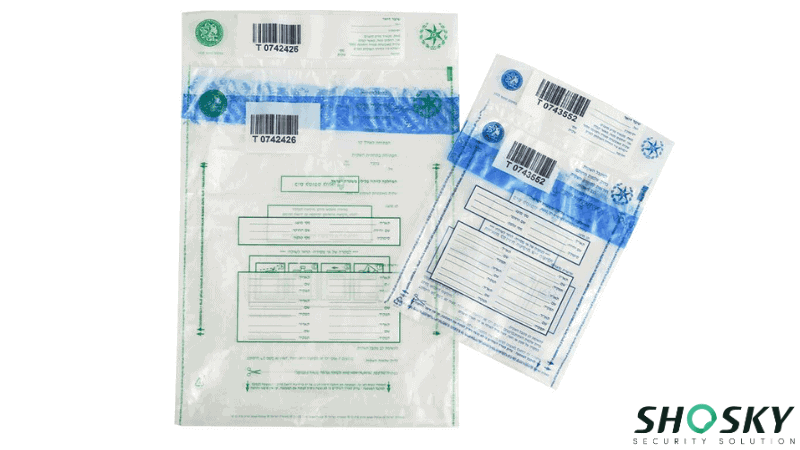
The old lock-and-key method banks once used to secure cash and valuables never guaranteed complete security; a lock can be picked, and a key can be duplicated without anyone knowing. Tamper-evident bank deposit bags solve that problem differently. Once sealed, a bag cannot be resealed without leaving obvious evidence, most commonly a printed “VOID” message that appears the moment the seal is disturbed.
This is a meaningful upgrade over a simple bank locker, where tampering can be harder to detect. If someone tries to reopen a sealed deposit bag, the attempt shows up immediately, whether through the VOID pattern, a thermochromic ink that reacts to heat, or a liner that reveals exposure to solvents like Freon.
Cash-in-transit and banking security vendors commonly build these bags to match the construction and labeling conventions used across the Federal Reserve system, including sequential serial numbers, matching tear-off receipts, and barcodes for CCTV-based tracking. That combination of features is what makes a bag’s condition on arrival meaningful evidence, not just a formality.
Because cash moves constantly between people and companies, this kind of documented seal matters at every handoff. These bags can also be customized with thinner walls without losing strength, keeping them light and easy to store in high volume.
2. Pharmaceutical Medication Bag
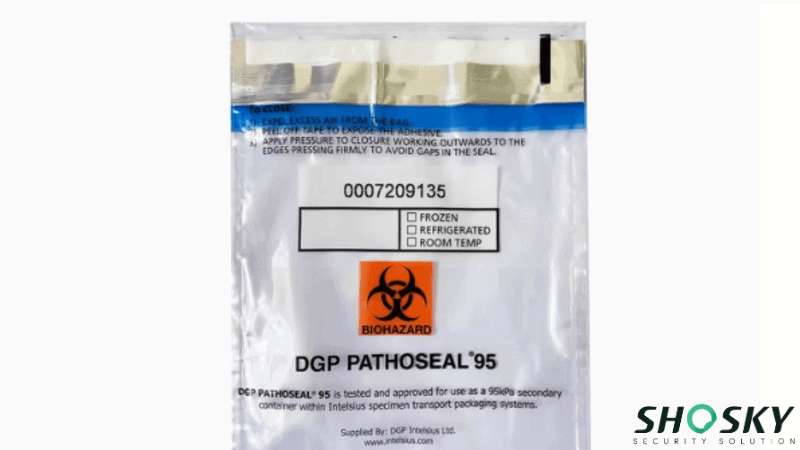
Tamper-evident security bags have become more common in pharmaceutical logistics for a straightforward reason: they help confirm that the right medication arrived in the right quantity and quality, from the point of origin to the point of dispensing. Clear tamper-sealed bags allow a handler to verify the contents without breaking the seal, speeding up inspection at every checkpoint.
These bags are also lightweight, which keeps shipping costs down without sacrificing seal integrity, and they’re generally affordable relative to the risk they offset. In the U.S., over-the-counter drug packaging is specifically required to carry tamper-evident features under 21 CFR 211.132, the FDA’s tamper-evident packaging rule for OTC human drug products.
A tamper-evident bag doesn’t replace that packaging requirement, but it adds a secondary layer of documented evidence during bulk transport and distribution, which matters given ongoing concerns about diversion of prescription and controlled substances.
Labeling on these bags typically restricts access to prescription-only medications, and because the seal itself is visibly damaged by any attempt at tampering, a compromised shipment is easy to flag before it reaches a patient.
3. Police Evidence Bag

Tamper-evident bags are widely used to store physical evidence in law enforcement and legal settings. Officers use them to keep evidence collected from a scene in its original, untouched condition from the moment of collection through to trial. A tamper-evident seal provides a documented answer to a question that comes up in nearly every case: was this item accessed by anyone after it was sealed?
The key detail here, and one worth being precise about, is that these bags are intentionally not resealable once opened. That’s the entire point. If someone tries to open a sealed evidence bag and then reseal it, the attempt is immediately visible, which is exactly the point the National Institute of Justice’s own evidence packaging guidance emphasizes when it comes to preserving the chain of custody.
These bags are commonly sealed with security tape, which serves as the adhesive closure, making the bag tamper-evident. Tape is available in full-transfer, non-transfer, or partial-transfer varieties, in various sizes and with custom printing, and many legal institutions use their own customized versions. Pairing a tamper-evident seal with a clear label helps investigators keep case information directly tied to the physical evidence, which matters just as much for confidential documents and files as for physical exhibits.
Ready to Get Tamper-Evident Bags for Your Business?
Start With A Low Minimum Order Quantity
4. Documents Security Bag
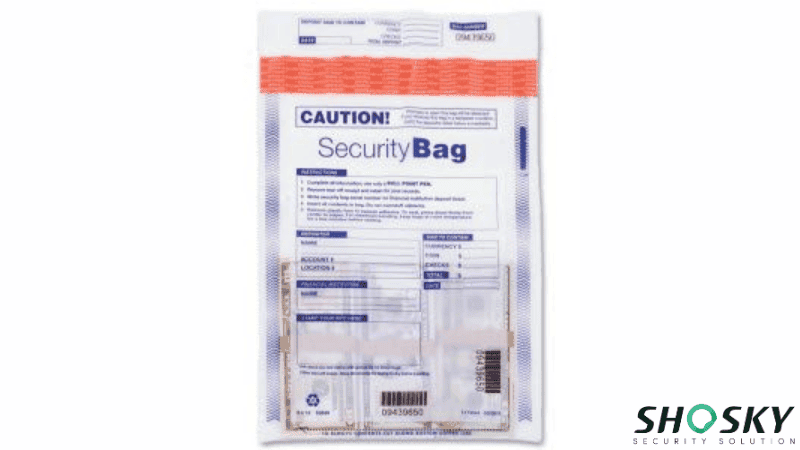
Confidential documents were moved between locations in ordinary paper envelopes or other packaging that offered no real protection against unauthorized access. Tamper-evident bags close that gap: any attempt to open the bag, even briefly, leaves a visible mark, which means sensitive information can travel with a documented guarantee that it wasn’t intercepted along the way.
Many tamper-evident document bags include a writable surface, so paperwork can be signed or annotated without altering the bag itself. Sequential barcodes and unique serial numbers add another layer, allowing a specific bag and everything inside it to be tracked from dispatch to delivery.
Banks, financial institutions, police departments, and other organizations that regularly handle sensitive paperwork rely on this format to move cash receipts, legal documents, and other confidential materials with a level of accountability that ordinary envelopes can’t match.
5. Security Packaging for Logistics
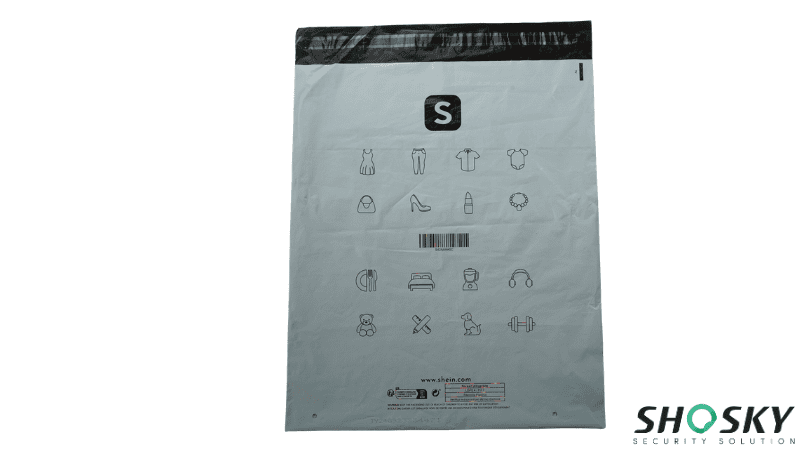
Logistics is fundamentally about getting goods to customers intact, and secure packaging is a direct input into that promise. Tamper-evident bag tape and seals give customers proof that what they received left the warehouse in its original condition, without any adulteration or unauthorized handling along the way.
That reassurance carries real weight given how much theft and tampering already happens in transit. Porch piracy alone accounted for an estimated 104.3 million stolen packages in the past year, according to SafeWise’s 2025 U.S. Package Theft Report, a cost shared between consumers and retailers that tamper-evident sealing can’t eliminate on its own but can at least make visible after the fact. Many sellers print a line directly on the seal, such as “do not accept if seal is broken,” to make that assurance explicit to the person receiving the package.
Beyond the security benefit, tamper-evident packaging is often cost-effective relative to the disputes and losses it prevents, while remaining durable enough for standard shipping conditions.
6. Casino Money Bag
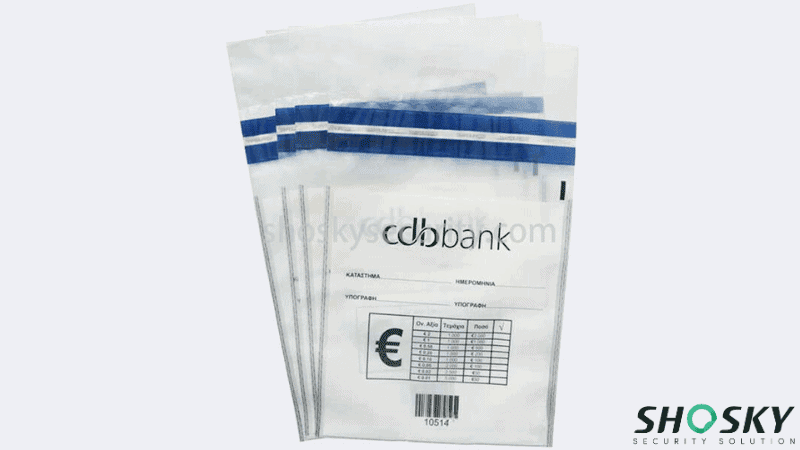
Handling and transporting cash, chips, dice, and cards is a constant operational challenge for casinos, and tamper-evident cash bags have become the standard tool for moving these items securely between the casino floor, the cage, and secure storage.
These bags can be customized to size and printed with the information needed for internal tracking, and the tamper-evident closure provides staff with a documented answer if a discrepancy arises during a cash count. That documentation matters beyond internal accounting: casinos with gross annual gaming revenue over $1 million are subject to the Bank Secrecy Act and must file a Currency Transaction Report for any cash-in or cash-out transaction exceeding $10,000, under 31 CFR 1021.311.
A clear, tamper-evident record of how cash moved between the point of collection and the count room supports that compliance obligation rather than working against it.
Comparing Tamper-Evident Bag Applications at a Glance
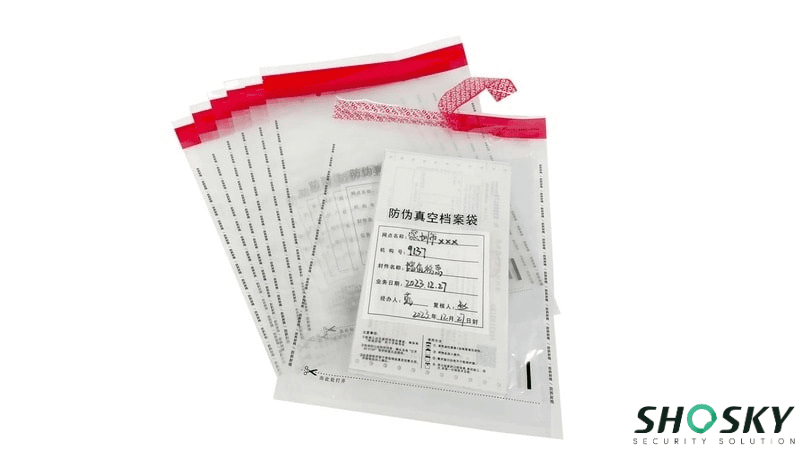
Each of these 6 applications relies on the same basic principle: a seal that fails visibly rather than quietly, but the risk it’s guarding against and the feature that matters most vary by industry. The table below summarizes that difference across all 6 use cases.
| Application | Primary Risk | Key Security Feature |
|---|---|---|
| Bank Deposit Cash Bags | Internal theft, resealing after removal | VOID seal, thermochromic ink, serialized barcode |
| Pharmaceutical Medication Bags | Diversion, contamination in transit | Clear film for inspection without opening, tamper seal |
| Police Evidence Bags | Chain of custody challenges in court | Non-resealable closure, documented serial tracking |
| Confidential Documents | Unauthorized access to sensitive information | Writable surface, barcode, non-resealable seal |
| Logistics Security Packaging | In-transit theft or product substitution | Printed warning message, tamper-evident tape |
| Casino Money Bags | Cash discrepancies, BSA reporting accuracy | Serialized tracking, documented seal for audits |
Most organizations end up combining more than one of these features rather than relying on a single one. A bank deposit bag, for example, typically pairs a VOID seal with serialized tracking, while a pharmaceutical shipment pairs a clear tamper seal with the batch documentation already required for the product itself.
How to Match Tamper-Evident Bag Specs to Your Security Risk Level
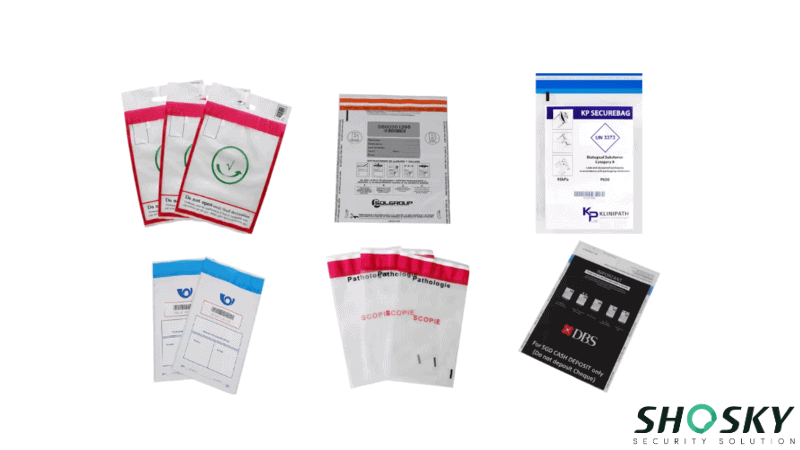
Knowing which application a bag is for is only half the decision. The other half is specifying the right film, closure, and tracking combination for that application, since two bags that both say “tamper-evident” on the label can perform very differently once someone actually tries to defeat the seal. A few variables matter more than most buyers realize when comparing suppliers:
- Film thickness and material: Co-extruded LDPE or HDPE films in the 2 to 4 mil range resist puncture and stretching better than thinner economy films, which matters most for cash bags and evidence bags that get handled roughly and often.
- Adhesive chemistry and dwell time: A tamper-evident seal only works if the adhesive has fully bonded before the bag is stressed. Suppliers who can provide peel-adhesion data referenced to a recognized method, such as ASTM D3330, are giving you something you can actually verify, rather than a general “high security” claim.
- Serialization and print options: Sequential numbering, barcodes, and custom warning text turn a generic security bag into part of an audit trail. This matters most for cash, evidence, and confidential documents, where proving exactly which bag went where is often as important as the seal itself.
Running through these three variables before placing a bulk order is what separates a bag that looks secure from one that actually holds up under a real attempt to defeat it. A quick sample test, peeling, chilling, and applying mild heat to a seal before committing to a full order, tends to reveal the difference faster than any spec sheet can.
FAQs
Q1: Can a tamper-evident security bag be resealed after it’s opened?
No. That’s the defining feature of a tamper-evident bag. Once the seal is broken, whether through peeling, heat, cold, or solvent exposure, the bag either shows a permanent “VOID” message or the film itself tears, and there’s no way to make it look untouched again.
Q2: Do tamper-evident bags meet banking industry standards?
Reputable cash-handling bag manufacturers build their bags to match the construction and labeling conventions widely used across the Federal Reserve system, including sequential serial numbers, matching tear-off receipts, and scannable barcodes. It’s worth confirming these specifics directly with a supplier rather than assuming every bag on the market meets the same bar.
Q3: Are tamper-evident bags required for over-the-counter medication?
Yes, in a specific sense. The FDA’s 21 CFR 211.132 requires tamper-evident packaging for over-the-counter human drug products sold in the U.S. A tamper-evident shipping or storage bag used during distribution is a separate, additional layer on top of that packaging requirement, not a substitute for it.
Q4: Why do casinos need tamper-evident cash bags specifically?
Beyond internal theft deterrence, casinos with gross annual gaming revenue over $1 million must comply with Bank Secrecy Act currency transaction reporting under 31 CFR 1021.311 for cash transactions over $10,000. A documented, tamper-evident record of how cash moved between the floor and the count room supports that reporting obligation and makes internal audits faster to resolve.
Q5: What’s the difference between tamper-evident and tamper-proof bags?
Tamper-evident bags don’t claim to make access impossible; they make any access attempt visible after the fact. Tamper-proof packaging attempts to physically prevent access altogether, which is far more expensive to engineer and rarely necessary outside a narrow set of high-security use cases.
Secure Your Supply Chain with Shosky Custom Security Bags
The use of tamper-evident seals for security purposes has simplified work in many areas. They have increased the reliability and safety of products and documents transported between areas. The best part is that these bags cannot be resealed, thus ensuring complete protection and satisfaction. They are available in a variety of shapes and sizes, serving a range of purposes.
One of the best companies operating in the domain of providing quality tamper-evident solutions is Shosky. It is synonymous with high-quality tamper-evident bags, security labels, security seals, and ultra-destructible seals. They are even specialized in providing customized tamper-evident solutions to meet the customer’s demands in the best possible manner. Check them out for exciting services at an affordable cost.