
A 2025 industry study by the National Insurance Crime Bureau highlights a sharp rise in cargo theft across global supply chains. Companies now face average losses of more than $200,000 per theft. Gaps in visibility during transit allow containers to move without tracking, which increases the risk.
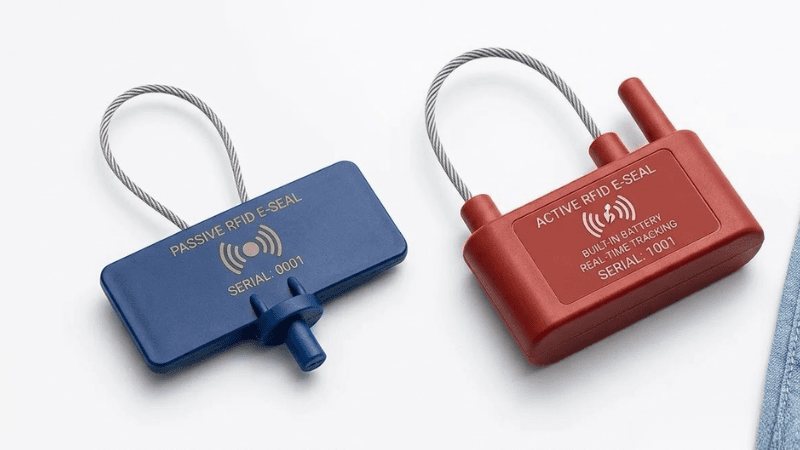
To bridge these visibility gaps, RFID e-seals transform traditional mechanical locks into intelligent data nodes. This article breaks down the technical differences between tamper-evident passive and active RFID e-seals to help logistics managers choose the right approach for real-time cargo tracking.
The Shift to Digital: Why Supply Chains Need Electronic Seals
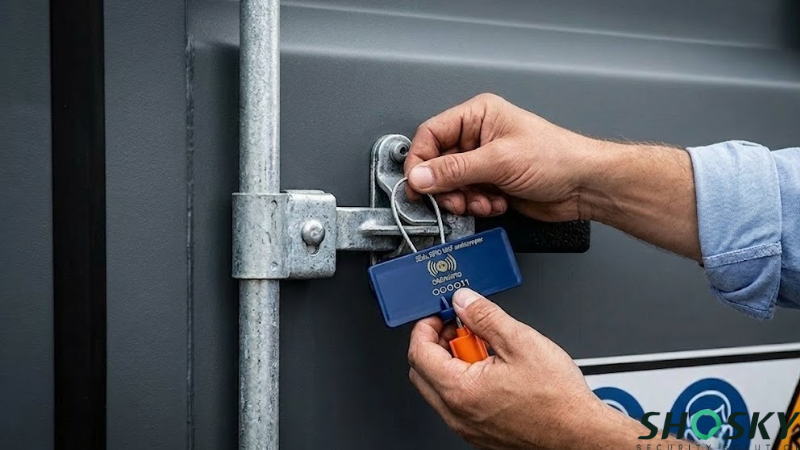
Traditional container seals provide highly basic physical protection. They operate on a simple mechanical principle: if the metal bolt is physically broken, something went wrong. However, these static seals only offer passive evidence, meaning you entirely discover a physical breach after the targeted shipment safely arrives at the receiving dock. It does not show exactly when or geographically where the criminal intervention happened.
This outdated mechanical approach creates massive logistical delays, severely raises the customs inspection rate, and dramatically slows cross-border clearance. Implementing an advanced electronic RFID seal immediately solves this critical data gap through these specific mechanisms:
-
Automated Data Capture: By integrating a specialized RFID chip directly into an ISO 17712-compliant bolt seal, these devices instantly record and transmit precise information regarding both the mechanical seal status and the unique shipment identity.
-
Gate Process Optimization: Automated scanning drastically supports the correct collection of encrypted information and totally reduces catastrophic manual entry errors during high-volume gate-in and gate-out terminal procedures.
-
Tamper Evident Alerts: Digital tamper-evident seals actively assist with high-level inventory management and heavily reduce the untracked movement of empty shipping containers.
When a high-security RFID bolt seal is permanently applied to heavy shipping containers, it immediately supports advanced global tracking, automated optical monitoring, and faster purchasing decisions. With significantly better tracking and optical monitoring, enterprise companies can strategically plan routes with much higher efficiency and aggressively protect valuable cargo from unauthorized physical access.
What Are Passive RFID Security Seals
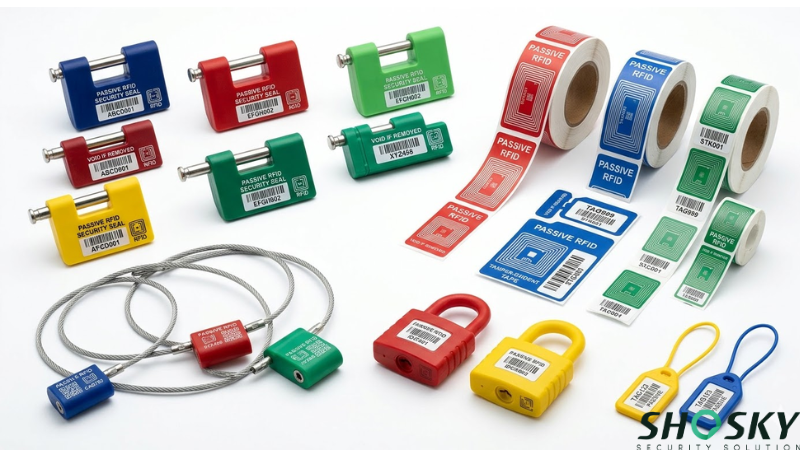
Passive RFID security seals are electronic security seal types that do not have their own power source. They rely on energy transmitted from an RFID reader to activate the embedded RFID chip.
These tamper-proof seals provide undeniable forensic tamper evidence and digital tracking strictly at authorized checkpoints. This architectural design makes them incredibly cost-effective for large-scale intermodal container monitoring without requiring continuous electrical power.
How They Work
When a radio frequency device sends a signal, the passive RFID bolt seal receives energy through radio frequency waves. This powers the RFID chip, which then sends data back to the RFID system‘s reader. This process, often utilizing UHF Ultra High Frequency technology operating between 860 and 960 MHz, supports identification and tracking at specific checkpoints.
These RFID bolt seals often use industrial-grade inlays inside the tag structure, which helps with stable data transmission during scanning, even in harsh port environments.
Pros
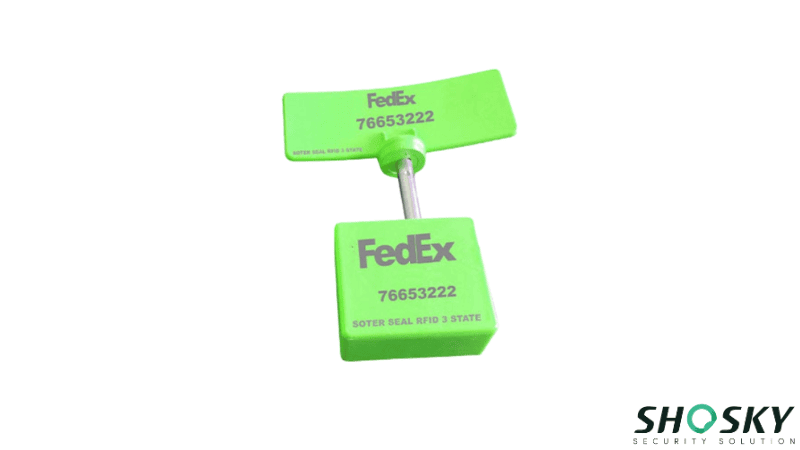
Passive RFID bolt seals are extremely cost-effective. Companies can deploy them across large numbers of containers without a major investment. The lack of a battery gives them an infinite shelf life and makes them fully disposable after use.
They are lightweight and easy to attach to containers. This supports high-volume logistics and fast deployment across global distribution networks. Many companies use passive RFID tag solutions for inventory management and routine cargo tracking.
Cons
The main limitation is checkpoint-dependent tracking. Passive systems depend on proximity to an RFID reader. This means tracking only happens when the tag passes through a checkpoint.
Seal status updates are not continuous. If a seal is tampered with between checkpoints, the system only detects it during the next scan, which may delay emergency response.
Best Use Cases
- Controlled environments such as warehouses, ports, and distribution hubs.
- Locations with fixed RFID readers for efficient scanning.
- Standard cargo and bulk shipments moving through regular transport routes.
- Companies seeking budget-friendly solutions without sacrificing traceability.
- Operations that require compliance and reliable monitoring at checkpoints.
Ready to Get RFID E-Seals for Your Business?
Start With A Low Minimum Order Quantity
What Are Active RFID Container Seals
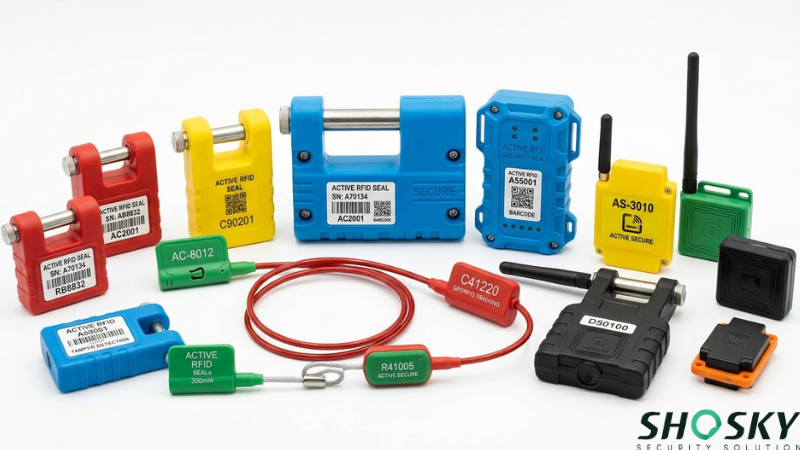
Active RFID bolt seals give continuous oversight for containers on the move. They strengthen security by notifying staff of any breaches immediately. Their design suits high-risk or time-sensitive shipments.
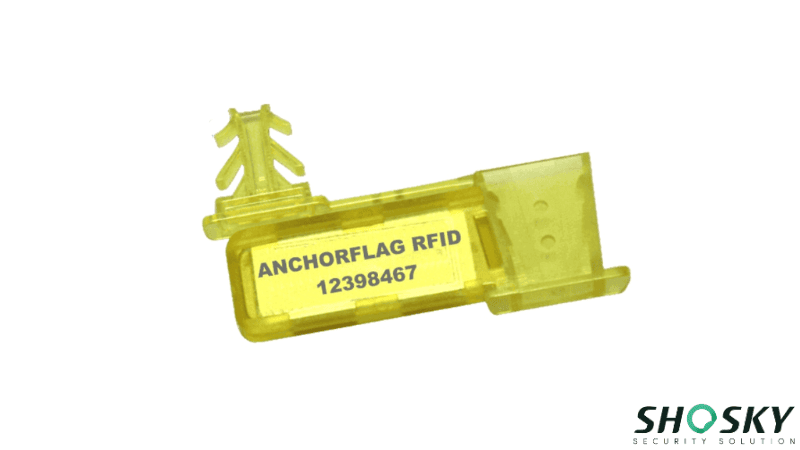
Their advanced internal design perfectly suits high-risk or highly time-sensitive international shipments. These heavy-duty seals take a completely different engineering approach from passive RFID security seals. Each active RFID bolt seal securely houses an internal battery that acts as its permanent primary power source. This critical component allows the active tag to transmit cellular signals without waiting for an external localized reader.
How They Work
An active RFID tag continuously sends data signals to nearby readers or gateways using active frequencies like 433 MHz or 2.4 GHz. The signal can include location, seal status, and container information. This supports uninterrupted tracking and monitoring during the entire journey.
The internal battery defines battery life and performance. Depending on settings, active RFID tags can operate for one to three years. The system can also adjust data transmission rates (ping rates) to balance battery life and tracking needs.
Pros
Active RFID bolt seals offer a long reading distance. Signals can reach over 100 meters, depending on setup. This allows tracking across large yards, ports, and transit routes.
The biggest advantage is instant tamper evidence; if the seal is compromised, the system sends an alert immediately. This protects cargo from unauthorized access and improves security.
Active systems provide real-time visibility. Companies can monitor cargo, location, and conditions without manual scans. This improves efficiency and helps companies respond to issues faster.
Cons
Active RFID solutions require a higher upfront investment due to the internal battery and added components. While they offer superior data, they also require compatible gateway infrastructure or GSM integration to transmit data in remote areas.
Additionally, battery life limits long-term use; once the battery runs out, the tag needs replacement or recharge.
Best Use Cases
- High-risk shipments that require constant oversight.
- Valuable or sensitive cargo, including electronics and pharmaceuticals.
- Cross-border transport with complex supply chain visibility needs.
- Shipments that need strong security and continuous real-time tracking.
- Cargo that benefits from instant tamper alerts and monitoring throughout transit.
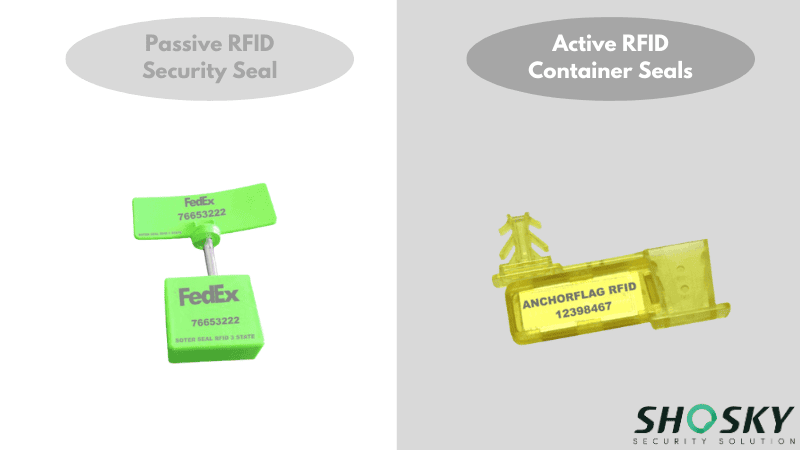
To better understand which e seal fits your operations, it helps to compare passive and active RFID bolt seals side by side. The table below highlights the key differences at a glance.
| Feature | Passive RFID Seal | Active RFID Seal |
|---|---|---|
| Power Source | No battery — powered by RFID reader | Internal battery — continuous broadcast |
| Read Range | Short: 1–10 meters | Long: Up to 100–150 meters |
| Tamper Alert Speed | Upon scanning at checkpoint | Instant real-time alert |
| Cost | Low — budget-friendly, mass deployable | Premium — higher upfront investment |
| Battery Life | N/A — infinite shelf life | 1–3 years depending on ping rate |
| Ideal Cargo | Standard bulk, high-volume shipping | High-value, sensitive, or Hazmat cargo |
| Traceability | Checkpoint-based | Continuous, route-level |
| Inventory Management | Excellent for warehouse environments | Best for in-transit monitoring |
Both seal types can be built into ISO 17712-compliant bolt or cable seal bodies, meaning compliance is not a differentiating factor. It is a baseline that either option can meet.
How to Choose the Right E-Seal for Your Supply Chain
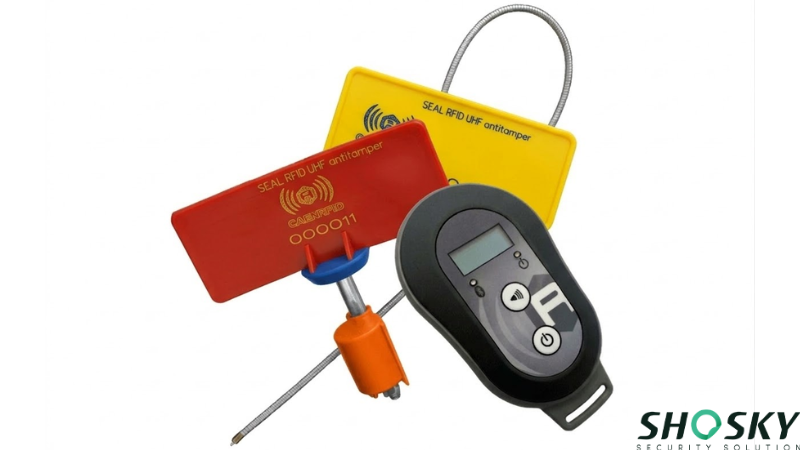
The right electronic seal depends on how your supply chain operates. Shipment value, transit distance, and the density of your checkpoint infrastructure determine whether a passive or active RFID seal is the best fit. Adhering to strict security guidelines established by programs like the Customs Trade Partnership Against Terrorism CTPAT strongly encourages the use of advanced electronic tracking.
Logistics managers actively deploy these premium devices to capture these extreme security benefits:
- Checkpoint control: Use passive RFID bolt seals if you have fixed scanning points in warehouses, ports, or distribution centers.
- Real-time monitoring: Choose active RFID bolt seals for cargo moving through multiple locations or over long distances.
- Security and compliance: Ensure the seal meets ISO standards and includes anti-tamper features to protect cargo integrity.
- System integration: Verify compatibility with existing RFID readers, software, and logistics platforms for seamless data collection.
- Testing and deployment: Conduct small-scale trials to check reading distance, data accuracy, and overall performance before full-scale implementation.
By evaluating these factors, companies can select an e seal that matches their operational needs while enhancing visibility, traceability, and cargo protection. Proper implementation ensures smoother customs clearance and reduces the risk of tampering throughout the supply chain.
FAQs
Q1: Are passive RFID bolt seals fully ISO 17712 compliant for international shipping?
Yes. High-quality passive RFID bolt seals seamlessly integrate the electronic chip inside a physical steel housing that strictly meets ISO 17712 High Security standards. This mechanical strength guarantees smooth global customs clearance and total compliance for all cross-border intermodal shipments.
Q2: How long does the internal battery last in an active RFID bolt seal?
Battery longevity strictly depends entirely on your configured reporting transmission frequency, known as the ping rate. Utilizing heavy-duty 10000 mAh internal batteries, most active RFID bolt seals operate continuously between one and three years when optimized properly through central management software.
Q3: Do I need specialized enterprise software to read and track RFID electronic seals?
Yes. Specialized middleware software is absolutely required to decrypt RFID bolt seal data and actively monitor shipments. Many modern enterprise tracking systems now seamlessly integrate directly with Global Supply Chain Visibility application programming interfaces to dramatically improve automated oversight and reduce manual data entry.
Protect Your Cargo Today with Shosky Security RFID Bolt Seals
Passive RFID bolt seals work well for high-volume shipments that pass through fixed checkpoints, keeping costs low. Active RFID bolt seals give real-time monitoring for high-value or sensitive cargo. Both security seals provide tamper evidence and traceability throughout the supply chain. What matters most is turning a mechanical seal into a digital data point, which sets companies ahead of competitors still relying on manual checks and plastic locks.
Don’t let your high-value shipments become another statistic. Shosky Security provides factory-direct RFID bolt seals and cable seals tailored for global logistics. Contact our technical team today for a free sample kit and a custom integration consult.