
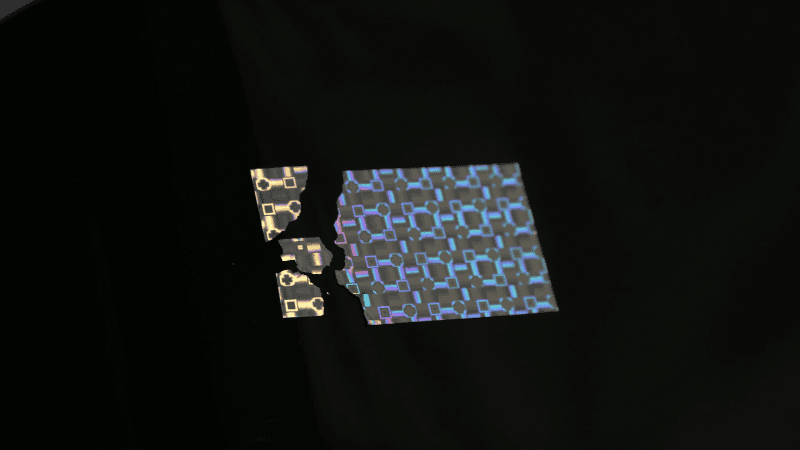
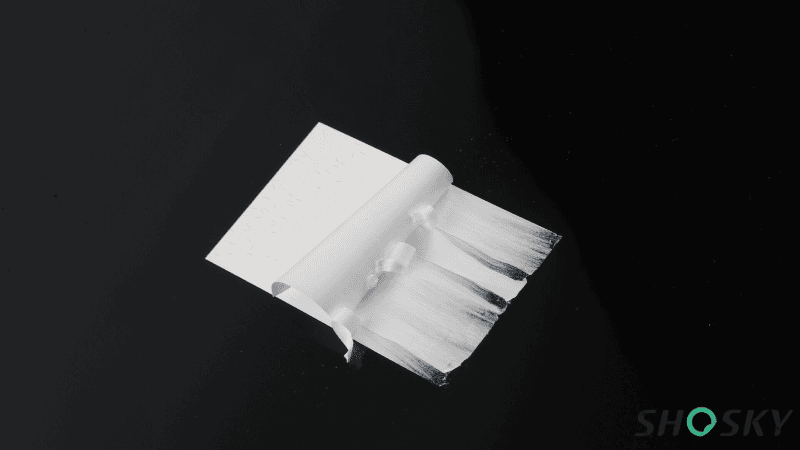
Every destructible label works on the same principle: the adhesive bond to the surface is engineered to be stronger than the label material itself, so picking or peeling breaks the face material instead of lifting it intact. That principle is narrower in practice than it sounds.
3M’s own technical data sheet for its destructible vinyl label material defines the expected result of a 180° peel adhesion test (ASTM D3330) not as a peel-force number, but simply as “label material destructs,” and the same sheet is explicit that this only happens if adequate adhesion develops first, something low surface energy plastics, contaminated surfaces, and textured substrates can all prevent.
“Destructible” is not a single material; it’s a family of constructions that solve the adhesion-and-fracture problem differently. This guide compares three of them: co-extruded film, Foamtac foam-based film, and hologram destructible labels, on how each one actually breaks, and which surfaces, curves, and environments each is built to handle.
How Destructible Labels Actually Break: Three Different Failure Mechanisms
The security function of any destructible label comes from controlled cohesive failure; the face material is formulated to fracture internally before it can separate cleanly from the adhesive layer beneath it. But co-extruded, Foamtac, and hologram constructions get there through different structures, and that structural difference is what determines which surfaces each one actually performs on.
Co-Extruded Film: Multi-Layer Structure, Controlled Interlayer Failure
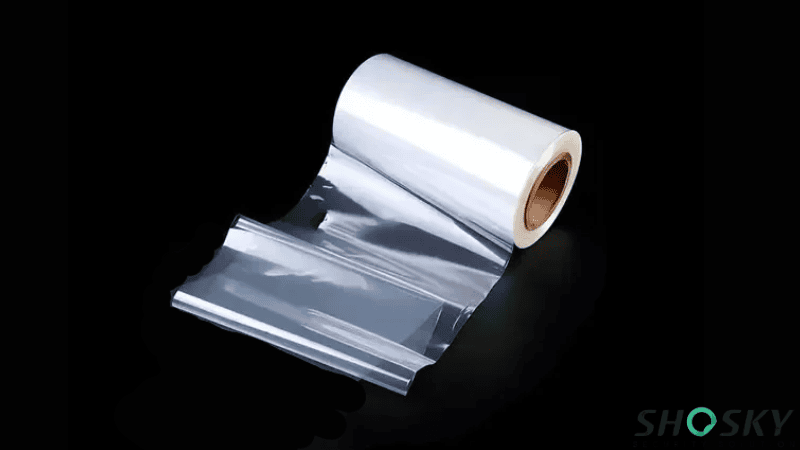
Co-extruded destructible label material is built from multiple polyethylene layers formed together in a single extrusion process, rather than a single brittle sheet. An outer layer is tuned for print receptivity, a core layer provides most of the film’s stiffness, and an inner layer is formulated for adhesive anchorage, all fused into a single structure during manufacturing rather than laminated afterward. That fusion is what lets the finished film survive printing and die-cutting while still being engineered to fail predictably later.
Patent literature on multilayer label film construction describes how manufacturers vary the ratio of low- and high-density polyethylene between layers to balance rigidity against controlled tearing, a trade-off a single homogeneous film can’t make without compromising one property for the other.
That layered control is why co-extruded film is the more common choice for larger or automatically dispensed labels: the outer and inner layers hold up through high-speed web handling and rotary die-cutting, while the internal layer boundaries are what’s engineered to give way when someone actually tries to remove the finished label.
Foamtac: Foam-Based Structure, Cohesive Failure Inside the Foam Layer
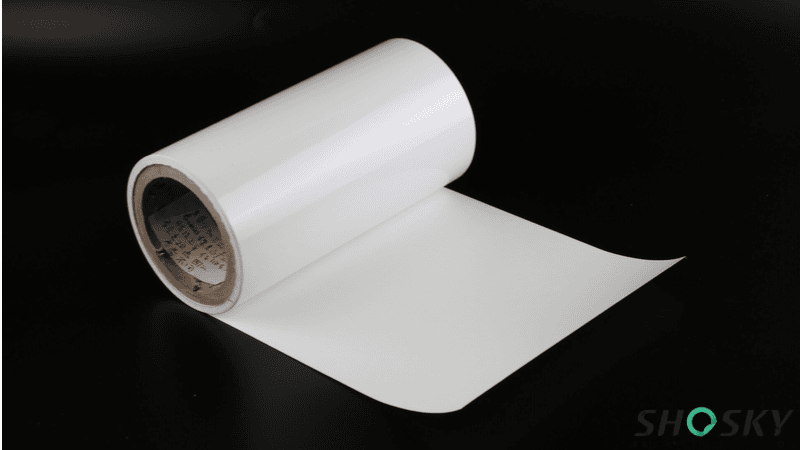
Foamtac destructible label material uses a thicker, foam-based structure instead of a thin flat sheet, solving a problem that sits upstream of fragmentation: adhesion.
A destructible film only works if the adhesive bonds to the surface first, and manufacturer technical guidance consistently states that rough, textured, or low-surface-energy substrates can prevent a thin, flat film from bonding at all. When that happens, the label simply peels off intact, regardless of how brittle it’s rated, and the security feature fails silently.
A foam-based structure solves this mechanically rather than chemically: the foam compresses into surface irregularities, casting seams, mold texture, and light pitting that a rigid flat film would otherwise bridge over without making full contact.
Once that stronger bond is established, the failure mechanism shifts as well: Foamtac fails cohesively within the foam itself rather than at a single interface, a fundamentally different mode from a co-extruded film’s interlayer separation. This is why Foamtac is purpose-built for rough or textured surfaces, where bonding must be addressed before brittleness becomes relevant.
Hologram Destructible: Optical Security Layered Onto a Fragile Base
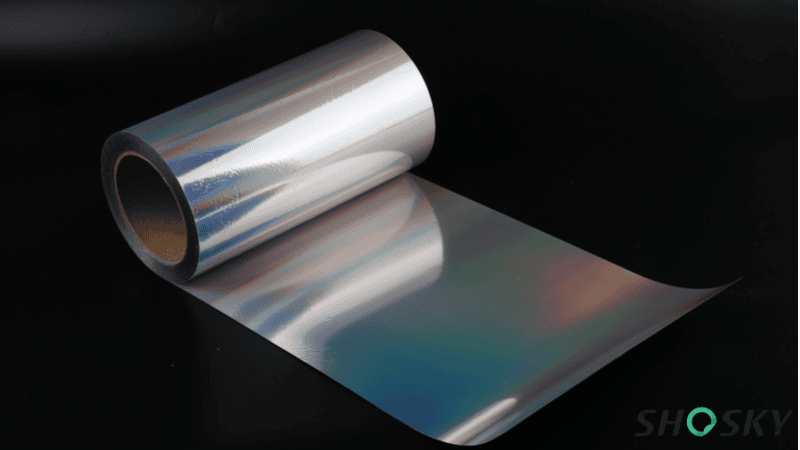
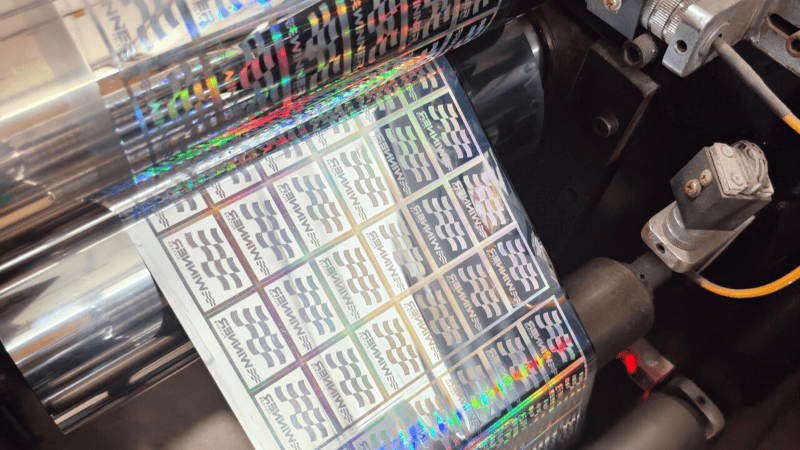
Hologram destructible labels start from the same brittle-film logic as standard destructible constructions, an engineered face material that fractures rather than lifts intact, and add a second, independent layer on top: an optically variable device, typically a diffraction pattern or holographic foil, laminated onto the fragile base before it’s converted into finished labels.
The label still fractures on removal exactly like any other destructible construction; what changes is what a counterfeiter actually has to defeat.
A diffraction pattern can’t be reproduced with standard color printers, scanners, or cameras, a point industry anti-counterfeiting technology guidance makes explicitly. Producing a convincing hologram requires specialized origination tooling to create the master pattern, a fundamentally different and far more expensive barrier than replicating a brittle film formulation.
That means a counterfeiter defeating a hologram-destructible label faces two unrelated problems rather than one: reproducing the base film’s fragmentation behavior and, separately, reproducing the optical pattern, using equipment and expertise that have nothing in common.
Matching Brittleness Grade to Your Application Surface
Once the mechanism is clear, the practical question becomes which grade actually holds up on the surface you’re applying it to. Brittleness grade determines the trade-off between maximum fragmentation and handling stability, and it’s a separate spec from which construction (co-extruded, Foamtac, hologram) you choose.
Shosky’s own destructible label line illustrates how this plays out in real specifications. HG80, a low-brittle-grade polyethylene film at 80 microns, is built for big or medium-size labels and supports automatic labeling and clean die-cutting, but it’s rated for flat or gently curved surfaces rather than tight radii.
MG80, a medium-brittle-grade vinyl at the same 80-micron thickness, conforms to irregular and curved surfaces, such as jar necks, cable seals, or small, rounded components, where HG80’s lower brittleness would make it more prone to cracking rather than fracturing cleanly.
Both are rated for a -5°C to 80°C service range and use acrylic adhesive on a glassine or craft paper liner; neither figure is a marketing claim; both come from the product’s own technical data sheet, which also notes that results should be confirmed through your own application testing before a production run.
Not Sure Which Destructible Grade Fits Your Product Surface?
Start With A Low Minimum Order Quantity
The table below summarizes how brittleness grade and construction type map onto common application scenarios.
| Surface / Scenario | Recommended Construction | Why |
|---|---|---|
| Large flat surfaces (crates, machinery panels, computer towers) | Co-extruded, low-brittle grade (HG80-type) | Supports automatic labeling and clean die-cutting at larger sizes |
| Curved surfaces (jar necks, cable seals, small electronics) | Medium-brittle vinyl (MG80-type) | Conforms to tight radii without cracking prematurely |
| Rough, textured, or molded plastic surfaces | Foamtac | Foam layer fills surface irregularities standard thin film can't bond to |
| Luxury goods, pharmaceuticals, high-counterfeit-risk products | Hologram destructible | Adds an independently-verified optical layer on top of fragmentation |
| Cold storage or low-temperature environments | Confirm service temperature range with supplier before ordering | Adhesive performance and film flexibility both shift outside the rated range |
Read the surface first, then the construction, then the grade. A rough plastic housing rules out a standard thin film regardless of the brittleness grade, since the adhesion problem must be solved before fragmentation behavior even matters.
What to Test Before Committing to a Production Run
Published specifications describe a material’s design intent, not a guarantee on your specific surface. Industry guidance from bodies such as FINAT, the trade association for self-adhesive label converters, consistently states that surface preparation and testing determine whether a destructible label actually performs as specified, regardless of the construction you choose.
- Surface energy matters as much as texture. High-surface-energy materials like steel and aluminum bond quickly and reliably. Low-surface-energy plastics like polyethylene and polypropylene resist adhesive wet-out, and a standard destructible label can peel off cleanly after 24 hours on these surfaces without fracturing, silently defeating the security feature.
- Contaminants defeat the bond before it starts. Oil, dust, or mold-release residue from plastic manufacturing prevents the adhesive from reaching the surface at all. A label applied to a greasy component will lift with the residue rather than shatter, regardless of how brittle the film is rated.
- Test on the actual production surface, not a lab panel. Peel adhesion, fragmentation behavior, and print durability can all vary with real-world surface texture, coating, and application pressure. Reference methods such as ASTM D3330 for peel adhesion and FINAT test methods for self-adhesive labels provide converters with a standardized way to compare results across trials.
- Confirm the service temperature range against your actual environment, not just room-temperature handling, since both adhesive tack and film flexibility shift outside a construction’s rated range.
None of these checks require lab equipment you don’t already have access to through a converter or material supplier. What they require is treating the spec sheet as a starting hypothesis rather than a guarantee, and confirming it against the surface, environment, and handling conditions the label will actually face before that decision is locked into a production order.
FAQs
Q1: Is Foamtac more secure than standard coextruded destructible film?
Not inherently. Foamtac solves adhesion challenges on rough or textured surfaces where thin films fail to bond. On smooth flat metal, both materials provide equivalent tamper evidence. Choice depends on surface texture rather than a security ranking.
Q2: Can a destructible hologram label be defeated by copying the holographic pattern?
No. Replicating the optical hologram does not bypass the fragile destructible base. An intruder still cannot remove the label from the original asset intact, preventing unauthorized transfer to a counterfeit product regardless of optical copying.
Q3: Why does a destructible label sometimes peel off intact rather than shatter?
This typically occurs due to low surface energy LSE plastics below 36 dynes per centimeter, surface oil contamination, or testing before the 24-hour adhesive wet-out time completes, causing adhesive failure before film destruction occurs.
Q4: What is the practical difference between HG80 and MG80 brittleness grades?
HG80 is a low-brittle polyethylene engineered for automated high-speed dispensing on large flat surfaces. MG80 is a medium-brittle vinyl designed to conform to curved geometries like jar necks without premature stress cracking.
Choose the Construction That Matches Your Surface, Not Just the Highest Security Rating
Co-extruded, Foamtac, and hologram-destructible labels all deliver the same core promise: irreversible fragmentation upon removal, but they achieve it through different material structures designed for different surfaces. Co-extruded film suits large, flatter formats where converting stability at scale matters. Foamtac earns its place on rough or textured surfaces a thin film can’t reliably bond to. Hologram constructions add an optical verification layer to products where the risk of counterfeiting justifies the added cost. The right choice starts with the surface in front of you, not the most aggressive brittleness rating on the spec sheet.
If you’re specifying a destructible label for a new product line or surface type, the team at Shosky Security can walk through construction options and brittleness grades for your specific application and send samples for your testing before a production run. Visit our contact page to request a technical consultation or a sample kit.