
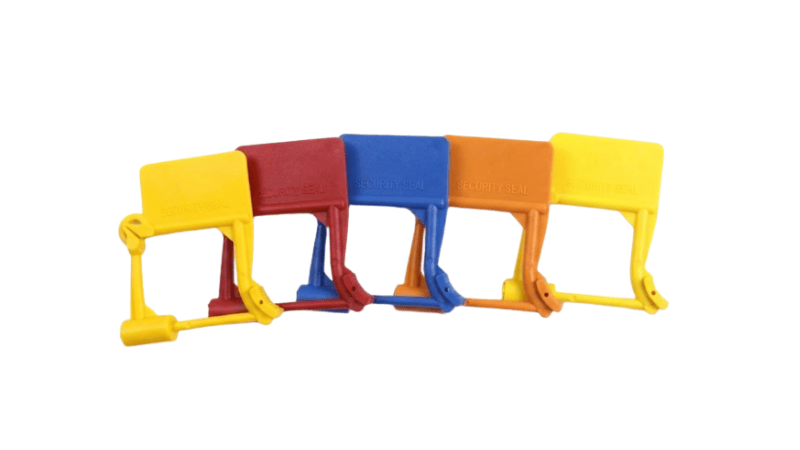
According to a Reusable Packaging Association report, companies that transitioned to returnable solutions reduced packaging costs by up to 35% over three years. The condition attached to that figure is that the tamper-evident solution packaging completes enough cycles per year to recover the upfront cost, typically a minimum of four full cycles annually.
Each cycle moves through carrier handoffs, storage, and distribution routes where tampering risk stays active. The tote box security seal is the only physical evidence that a tote box arrived the way it left. Choosing the wrong one quietly erodes the entire cost case for returnable packaging. This guide is intended for procurement teams managing these decisions.
The Engineering Mechanics of Attached Lid Container Seals
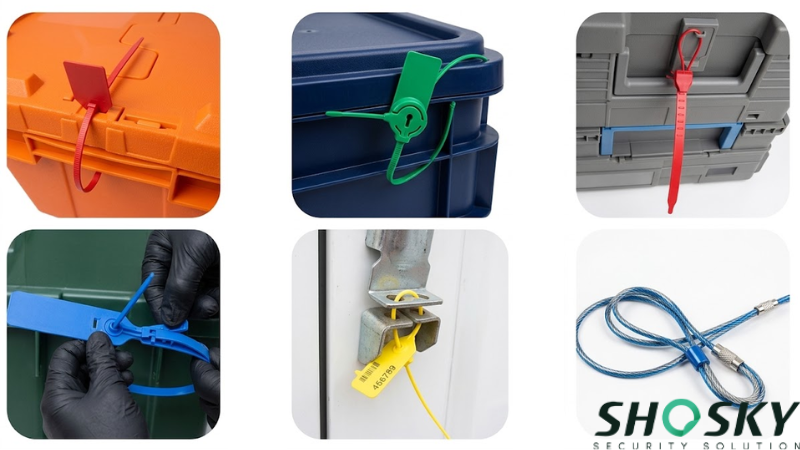
Attached Lid Containers are built for repeated transport, storage, and distribution cycles. Their lids connect directly to the body through interlocking hinges, making them more durable and easier to reuse than standard boxes.
However, their fixed lid structure requires a seal built specifically for it. Standard closures provide no tamper identification and no way to collect evidence of unauthorized access. A dedicated tote box security seal solves both problems directly through three core design features.
- Dual Locking Prongs: Pass through the interlocking hinge points of the tote boxes to create a secure lock. If an intruder attempts to pry the lid open, the plastic seal must break first, making tampering immediately visible during dock review.
- Toolless Application Mechanism: Enables warehouse staff to apply the seal with a simple manual push. This saves time, improves order fulfillment speed, and makes high-quantity packaging operations highly efficient.
- Low Tensile Break Point: Allows receiving teams to remove the seal quickly without damaging the expensive reusable container. A controlled break point ensures staff can snap the seal open by hand instead of relying on heavy-duty cutting tools.
This precise balance between strong security and easy removal is what makes attached lid container seals effective. They create clear accountability without slowing down daily operations. For procurement teams, this translates directly to better inventory protection, lower costs from damaged stock, and smoother returnable packaging cycles.
Categorizing Tote Box Security Seals for Different Container Designs
In returnable packaging networks, tote boxes often vary in design, size, and locking points. One seal type cannot always secure every container properly. The options below are designed to match the main container variations used in procurement and logistics systems.
1. Dedicated Tote Pins
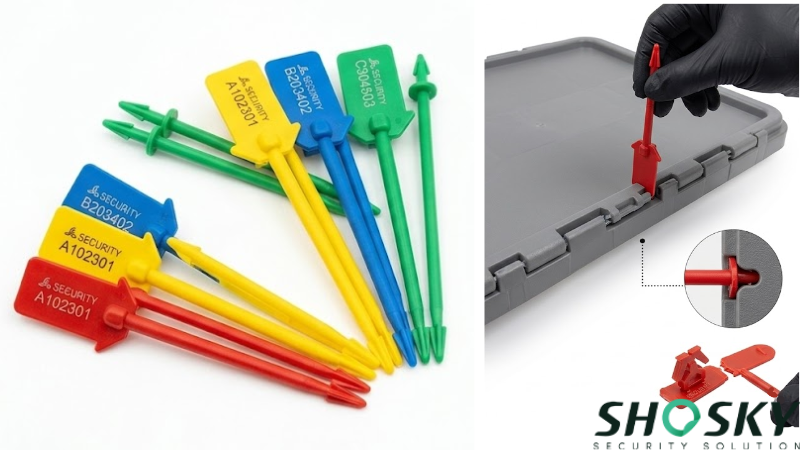
Dedicated tote pins are push-fit arrow seals made specifically for attached lid containers. These security seals are used in standardized returnable packaging fleets where tote boxes share the exact same design and hole layout. Before placing a bulk purchase order, sourcing directors must confirm several operational parameters.
- Hole Size Compatibility: Confirm that the tote box hole dimensions match the pin head diameter across your entire logistics fleet.
- Material Temperature Rating: Ensure the seal material is officially rated for your specific storage temperature range, especially in cold chain environments.
- Direct Body Printing: Verify that serial numbers or company branding are printed directly on the pin body rather than on a separate vulnerable tag.
- Order Volume Match: Check that the manufacturer’s minimum order quantity aligns with your monthly cycle volume to avoid stock gaps.
Tote pins represent the most cost-effective option per unit at high quantities. For procurement teams running large standardized fleets, they offer the fastest application, the cleanest removal, and the most straightforward path to a customized serialized auditing program.
2. Pull Tight Plastic Seals
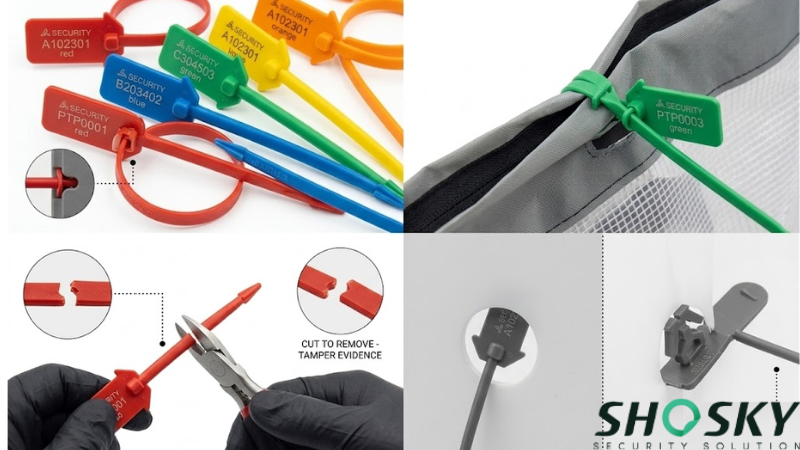
Pull tight plastic seals are adjustable strap seals that cinch down through non-standard or irregular openings. These tamper-evident solutions are the practical choice when a fleet includes tote boxes from multiple manufacturers, or when the operation needs to secure bags, pouches, and containers that cannot accept a rigid pin.
The strap adjusts to fit, locks under tension, and is cut to remove. Procurement teams should choose pull tight seals when:
- Mixed Packaging Use: When soft bags and irregular packaging are part of the exact same returnable cycle as rigid boxes.
- Multi Container Compatibility: When the warehouse operation includes completely different container shapes and hardware sizes.
- Clear Tamper Evidence: When operations demand obvious visual tamper evidence at receiving, with zero possibility of reusing a cut seal.
- Access Proof Requirement: When strict pharmaceutical and food supply chains legally require a visibly broken seal as definitive access proof.
The cut-to-remove mechanism means these seals provide strong physical evidence and protect against stealth substitution. A thief cannot replace a cut strap with an identical one without the unique serial number mismatch becoming instantly visible during the receiving inspection.
3. Plastic Padlock Seals
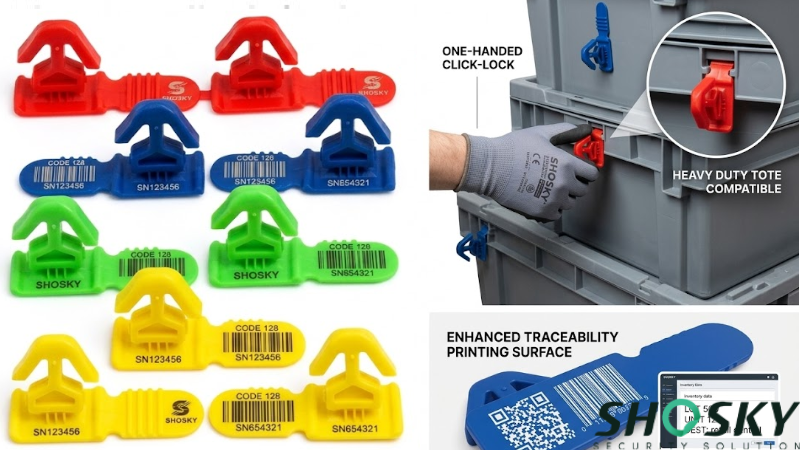
Plastic padlock seals use a hook-based locking mechanism that clicks into place with one hand. They are built for heavy-duty distribution totes used in retail, automotive parts, and industrial supply chains where dock workers handle large volumes under time pressure.
Single-handed application keeps the process fast without sacrificing the lock integrity. They work best when the operation involves:
- Large Hinge Openings: Designed specifically for heavy-duty tote boxes featuring large hinge openings that accommodate padlock-style hasps.
- Fast Dock Operations: Perfect for high-throughput loading docks where two-handed sealing drastically slows down the daily workflow.
- Visible Route Protection: Ideal for multi-carrier routes where highly visible padlock seals help reduce opportunistic tampering.
- Easy Distance Identification: Suited for facility operations that require a security seal that is easy to spot and verify from a distance.
Plastic padlock seals are also well-suited for use in conjunction with inventory tracking systems. The padlock body provides more surface area for printing serial numbers, barcodes, and company branding than a standard pin, which makes it a strong choice for operations running detailed shipment-level traceability.
The Sourcing and Validation Checklist for Tote Stock Seals
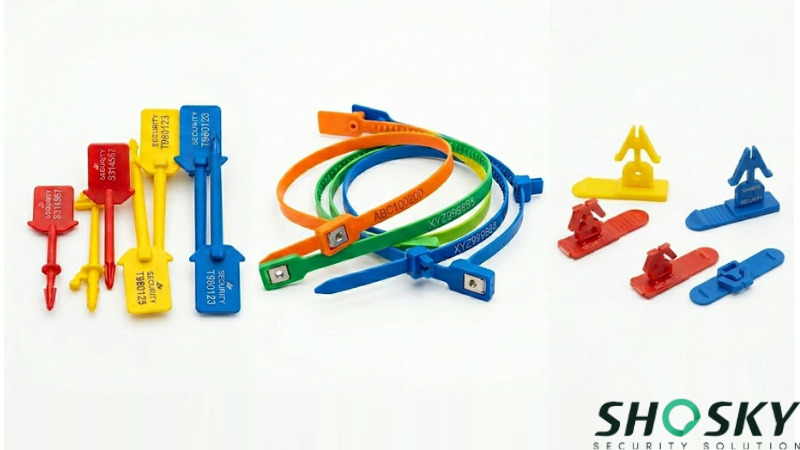
Price per unit gets the most attention in seal sourcing decisions. It should not get the most weight. A seal that fails in a cold storage facility, carries no branding, or runs out of stock mid-quarter costs far more than the difference between a cheap supplier and a reliable one.
Before approving any manufacturer, sourcing directors should run the following validation checks that go beyond the quote.
| Validation Criteria | What to Check | Why It Matters |
|---|---|---|
| Material Grade Verification | Ask for polypropylene specs and cold test samples | Low-grade plastic can crack in cold storage and transport |
| Custom Branding Capacity | Check logos, barcodes, and serial print quality | Prevents seal swapping after tampering |
| Volume Production Stability | Review lead time and factory output capacity | Avoids supply gaps in high-volume operations |
| Cold Chain Compatibility | Test seals at full temperature range | Prevents failure in freezing or heat conditions |
| Serial Number Sequencing | Confirm a unique, sequential numbering system | Maintains traceability across shipments and carriers |
A direct factory supplier provides more than competitive costs. It provides visibility into the production process, the ability to customize seal specifications, and a single point of accountability when quality issues arise.
Resellers working through intermediaries cannot offer that level of control, and for operations where seals are the primary tamper evidence in a liability dispute, that control is what protects the company when inventory goes missing.
Seal Disposal and Single-Stream Recycling Compliance
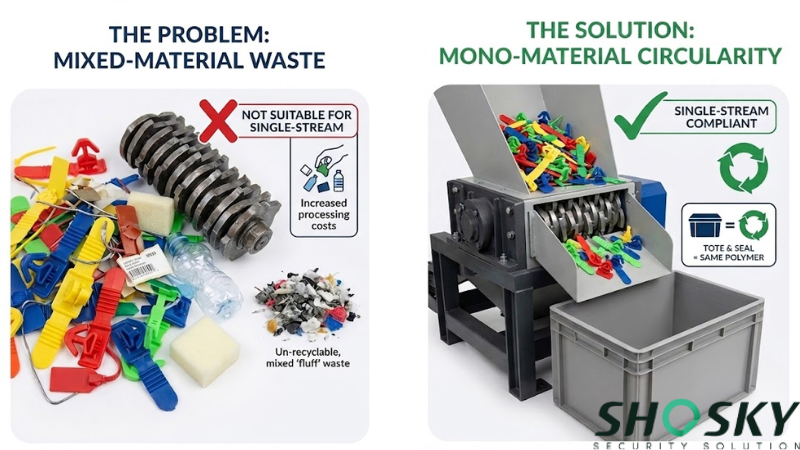
Large logistics networks generate seal waste fast. A distribution center processing 10,000 tote cycles per day also generates 10,000 broken seals per day. At that volume, disposal becomes a compliance issue, not a facilities question. Procurement teams should review:
- Material Tracking Requirements: ESG standards such as the GRI 306 Waste Standard require companies to record how packaging waste is handled and recycled.
- Recycling Complexity: Mixed material seals often require manual separation before recycling, adding massive labor costs and pressure during audits.
- Single Stream Recycling: Mono material seals made from the same polymer family as the tote boxes allow both items to enter the exact same recycling stream without extra sorting.
- Waste-Based Compliance Fees: Supply chains operating under extended producer responsibility rules face higher fees if plastic waste volumes are managed inefficiently.
Choosing seals that match your tote box material structurally helps simplify recycling programs and supports much cleaner corporate compliance records. It drastically reduces waste handling costs and makes large-scale returnable packaging systems easier to manage over the long term.
Expert Tip from Shosky Security: One Pin, One Liable Party
When clients ask about tote pin ROI, the answer is never just shrinkage reduction. The real value is liability deflection. When a serialized Shosky seal locks a tote at dispatch, financial responsibility transfers to the third party carrier the moment they sign for the shipment. If that tote arrives with a broken pin and missing inventory, the carrier pays. The serial number is the evidence that closes the dispute. Buyers are not purchasing a piece of plastic. They are purchasing a legal handover protocol.
FAQs
What is the primary purpose of a tote box security seal?
A tote box security seal provides irreversible visual evidence of tampering for attached lid containers. It ensures that inventory remains secure during transit and transfers financial liability to the carrier if the seal is broken or missing upon delivery.
Can tote box pins be reused after they are removed?
No. Professional tote pins and plastic padlock seals are engineered for single-use destruction. Once the receiving teams snap or cut the locking prongs, the structural integrity is permanently destroyed, making it impossible to reuse the seal or conceal unauthorized access.
How do mono-material security seals improve recycling compliance?
Mono material security seals are manufactured from the exact same plastic polymer family as the returnable tote boxes. This design allows warehouse facilities to process broken seals and damaged containers in the same single-stream recycling process without expensive manual sorting.
Get Reliable Protection with Shosky Returnable Packaging Seals
Returnable packaging reduces waste and long-term costs, but only when control is maintained across every movement. Without reliable seals, even durable tote boxes lose their advantage, as visibility over tampering and responsibility becomes unclear during transport cycles.
Shosky Security offers various tamper-evident solutions, including tote box security seals built for logistics environments. If your company is reviewing returnable packaging security, now is the time to upgrade. To learn more or place an order, contact our team and review samples to see how the seals perform in real logistics conditions.